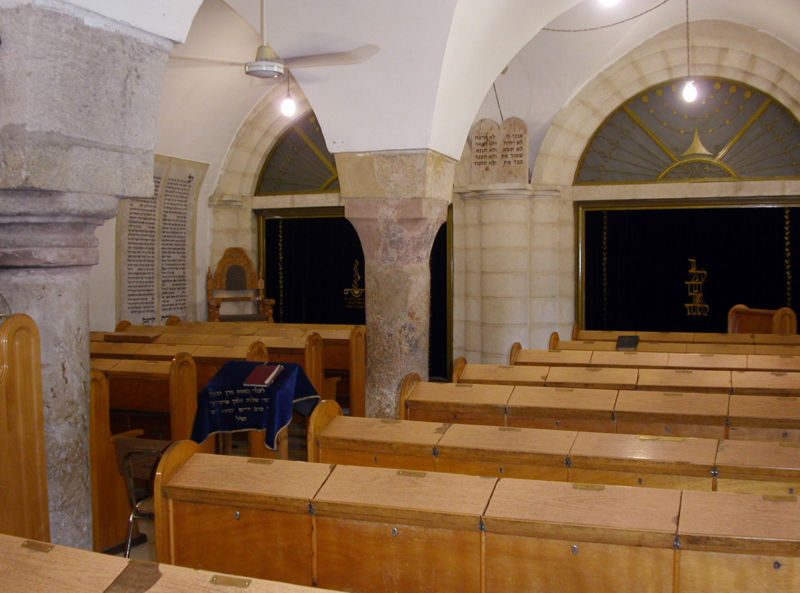
In Jerusalem's Jewish Quarter, a short walk from the Hurva, a narrow stairway drops below the level of the street and opens into a low, vaulted prayer hall. There is no dome, no grand facade, nothing to catch the eye from above - which is rather the point. This is the kenesa of the Karaite community, a synagogue built down rather than up, and one of the oldest houses of Jewish prayer in the city still in active use.
Karaite Judaism holds to the authority of the written text of the Hebrew Bible over the Oral Law codified in the Talmud, a position that put it at odds with rabbinic Judaism from an early stage and produced its own distinct communities, calendar calculations and prayer customs. Jerusalem was a centre of Karaite scholarship in the medieval period, and the community maintained a presence in the Old City for centuries, worshipping in this same sunken hall long after the city changed hands many times over.
Below the street, on purpose
Local tradition explains the depth of the hall by reference to Psalm 130: "Out of the depths I have cried to you, ה׳." Worshippers descending the stairway are, on this reading, enacting the verse each time they enter. Whether the builders set out with that verse in mind or simply built on top of ground that had already risen around them through centuries of rubble and rebuilding, the effect is the same: prayer here happens beneath the surface of the modern city, in a room whose floor predates the pavement around it.
The Karaite community in Jerusalem attributes the founding of its congregation to a period reaching back to the early medieval centuries of Karaite activity in the city, when scholars associated with the movement settled and studied there. The precise building history of the current structure - what has been rebuilt, when, and how much of any earlier fabric survives beneath later repairs - is not settled by a single inscription or document, and the community's own oral tradition of great age sits alongside the harder task of dating the visible stonework course by course.
A working synagogue, not a ruin
The kenesa is not a museum piece behind glass but a functioning prayer hall, used by Jerusalem's small Karaite community for services on the Sabbath and festivals according to the Karaite calendar and liturgy, which differ from rabbinic practice. Like the rest of the Jewish Quarter, the building was cut off from Jewish use between 1948 and 1967, when the Old City was under Jordanian control, and was restored along with the Quarter's other synagogues after 1967. Its continued use today, in a building whose core long predates the modern state around it, is itself part of what it demonstrates: an unbroken thread of a minority Jewish tradition maintaining a physical foothold in Jerusalem across regime change, siege and exile.
Jewish Quarter, Jerusalem - in situWhat the building argues
A synagogue that has to be excavated to be entered is a kind of evidence in its own right. It shows a floor level from an earlier city, buried under the accumulated centuries the way most of the Old City's ancient ground is buried, and a community that kept using the same spot rather than abandoning it to rebuild higher, as happened all around it. The kenesa's low profile also reflects a period, under various rulers of Jerusalem, when non-Muslim houses of worship were restricted in height and visibility relative to mosques - an external constraint as much as an internal choice, and one that shaped the outward modesty of more than one Jerusalem synagogue of the period, not only this one.
The scholarly debate around the building is less about whether it is old - the depth of the floor and the character of the vaulting both argue for real antiquity - and more about how much of the present fabric is original versus the product of repeated restoration after earthquakes, fires and periods of neglect that affected the whole Jewish Quarter. Building histories of this kind are commonly established through a combination of the structure's own masonry, waqf and property records where they survive, and the continuous testimony of the community that used it, rather than through a single dated inscription. That mix of physical and documentary evidence is ordinary for old Jerusalem buildings and does not weaken the case for the site's antiquity; it simply means the case is built, appropriately, in layers.
Karaite Judaism in Jerusalem
Karaite Jews rejected the authority of the Oral Law and based observance on the biblical text alone, a stance that generated its own legal and liturgical tradition distinct from rabbinic Judaism. Medieval Jerusalem hosted a significant Karaite scholarly community, part of a wider network with centres elsewhere in the Middle East and in Byzantine and later Ottoman lands. The Jerusalem kenesa is the physical remnant of that presence in the city, and the small Karaite community there today traces its use of the building back through that longer history.
Jewish Quarter, Jerusalem - in situFurther reading