The coast of Israel offers almost nothing a harbour needs. No natural bay breaks the shoreline between Jaffa and Dor, no headland shelters a fleet from the open Mediterranean, and the prevailing current runs south, dragging sand along the beach without pause. Herod the Great built a major harbour there anyway, at a site he named Caesarea in honour of Augustus. He did it by pouring concrete into the sea itself, in quantities and by methods that put the site among the more instructive pieces of Roman-period engineering anywhere in the Mediterranean. The submerged remains of that harbour, mapped and excavated over decades by underwater archaeology, are the evidence. They corroborate, in stone and mortar rather than in text, a story the ancient historian Josephus tells about a king who built a port from nothing and called it after his patron.
Caesarea itself lies on Israel's central coast, roughly midway between modern Haifa and Tel Aviv. Herod founded the city in the last decades of the first century BCE, and it became, for the following centuries, the principal port and eventually the Roman administrative capital of the province. The harbour was the reason the city existed at all: without an anchorage, there was no case for a city on that stretch of coast.

What the sea preserved
Ancient harbour builders normally relied on nature: a bay, a lagoon, an offshore reef to break the swell, and then modest human additions to finish the job. Caesarea had none of that, so the breakwaters had to be built essentially from scratch, running out from an open, sandy shoreline directly into deep water. The scale recorded by Josephus, who describes a harbour built to rival the greatest of his day, has been borne out by what divers and surveyors have found on the seabed: an artificial harbour of substantial size, formed by two long moles enclosing a basin, with a further breakwater protecting the entrance.
The method is what makes the site remarkable as evidence rather than merely as a ruin. Roman builders had access to a volcanic ash, known today as pozzolana, that reacts with lime and seawater to set hard even underwater - a genuine hydraulic concrete. At Caesarea, excavators have found and studied the wooden forms into which that concrete was poured directly in the sea, some evidently built and floated into position before being filled and sunk in place. Cores drilled from the surviving concrete masses show the aggregate and lime mix in cross-section, and the composition matches the hydraulic-concrete recipe described in Roman technical writing of the period. This is not a harbour improved with concrete; it is a harbour created by it, in open water, at a scale with few equals from antiquity.
Sebastos, the harbour of Caesarea
Josephus records that Herod built the harbour, which he calls Sebastos - the Greek form of Augustus - in a location with no natural shelter, using stone and hydraulic concrete lowered into the sea to form two great moles. Underwater survey and excavation from the later twentieth century onward have located and mapped the submerged breakwaters, wooden concrete forms, and harbour basin on the seabed off modern Caesarea, matching the scale and general layout Josephus describes.
In situ, Caesarea Maritima; Israel Antiquities AuthorityWhy it sank
The harbour did not survive as intact ruins standing on dry land, and that failure is itself part of the evidence. Within a few centuries of construction, much of the northern breakwater had subsided below the waterline, and today the outline of Herod's harbour lies mostly underwater, which is precisely why divers rather than field archaeologists on foot first began to trace its plan. Geologists and archaeologists working on the site have proposed a combination of causes: the coast in this stretch sits near a fault zone prone to gradual subsidence, the great concrete blocks were heavy enough to compress the sandy seabed they rested on, and the harbour may also have been struck by tsunami waves, of the kind independently attested along this coast in the Roman period. No single explanation has been agreed to the exclusion of the others, and the honest position in the scholarship is that the collapse was probably the product of more than one process acting together over time.
What is not in dispute is that the harbour worked, at least for a period. Ancient writers describe ships using it, and the archaeological remains include not just the breakwaters but warehouse foundations, a temple platform overlooking the basin, and other installations consistent with a functioning commercial port rather than an abandoned scheme. Caesarea went on to become one of the principal ports of the eastern Mediterranean under Roman rule, and later served as the seat of the Roman and then Byzantine administration of the province - a status the harbour's early success made possible.
Underwater concrete construction
Cores taken from the surviving concrete masses at Caesarea show a mix of lime, volcanic ash and aggregate consistent with the hydraulic concrete described in Roman engineering writing of the period, a material capable of curing underwater. Timber formwork recovered on the seabed indicates that at least some of the concrete moles were cast in place at sea rather than built up from blocks laid by hand, an unusually ambitious method for its time. The findings come from decades of underwater excavation and survey conducted at the site.
Underwater excavation, Caesarea Maritima; published findings, Israel Antiquities AuthorityWhat it corroborates
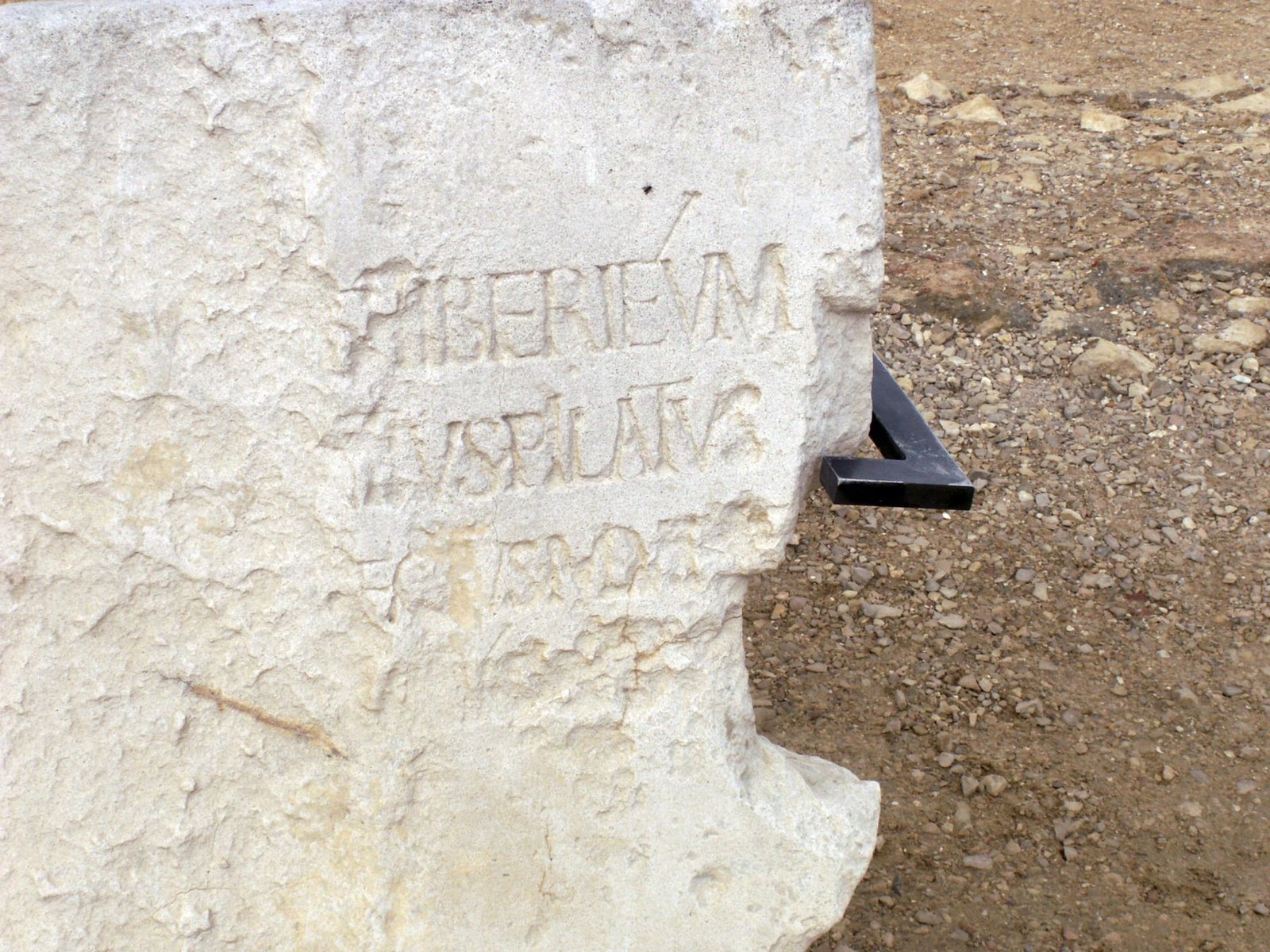
For the study of the Jewish past specifically, the harbour matters less for what it says about concrete and more for what it confirms about the world Herod built and the province that followed him. Caesarea became the administrative heart of Roman Judaea, the city from which prefects and procurators governed - Pontius Pilate among them, a connection independently fixed by an inscribed stone found at the site bearing his name and title. A functioning deep-water port there is not incidental background to that history; it is the infrastructure that made Caesarea, rather than Jerusalem, the seat of Roman power in the province, with everything that followed from that arrangement. The submerged breakwaters are a rare case where an ancient text's claim about scale and ambition can be checked directly against physical remains still lying where they were built, rather than against a later copy, a coin, or a secondhand account.
Further reading