Walk into the ruined synagogue at Hammat Tiberias, on the western shore of the Sea of Galilee just south of Tiberias, and the mosaic floor still does something unusual for a Jewish house of prayer: it puts a wheel of the twelve zodiac signs at the centre of the room, and at the centre of that wheel a chariot-driving sun god, radiate crown and all, that any visitor to a Greco-Roman temple would recognise on sight. The floor is not an accident of taste. It is a deliberate, literate composition, carrying Hebrew and Greek inscriptions alongside the imagery, and it survives largely intact in the building where it was laid.

What the floor shows
The mosaic is laid out in three registers, one above the other, filling the nave of the synagogue's prayer hall. At the near end, closest to the entrance, a panel names and honours the donors who paid for the floor. At the far end, nearest where the Torah shrine stood, a panel shows Jewish ritual objects: a menorah flanked by a shofar, an incense shovel, a lulav and etrog, and other implements of Temple and synagogue worship, rendered with obvious care. Between the two sits the zodiac roundel: an outer ring of the twelve signs, each labelled in Hebrew, running round a circle; a middle ring showing personifications of the four seasons, also labelled in Hebrew, in the corners of the square that frames the circle; and, at the very centre, the sun god Helios, standing in a four-horse chariot, one hand raised, encircled by a ring of stars and a crescent moon.
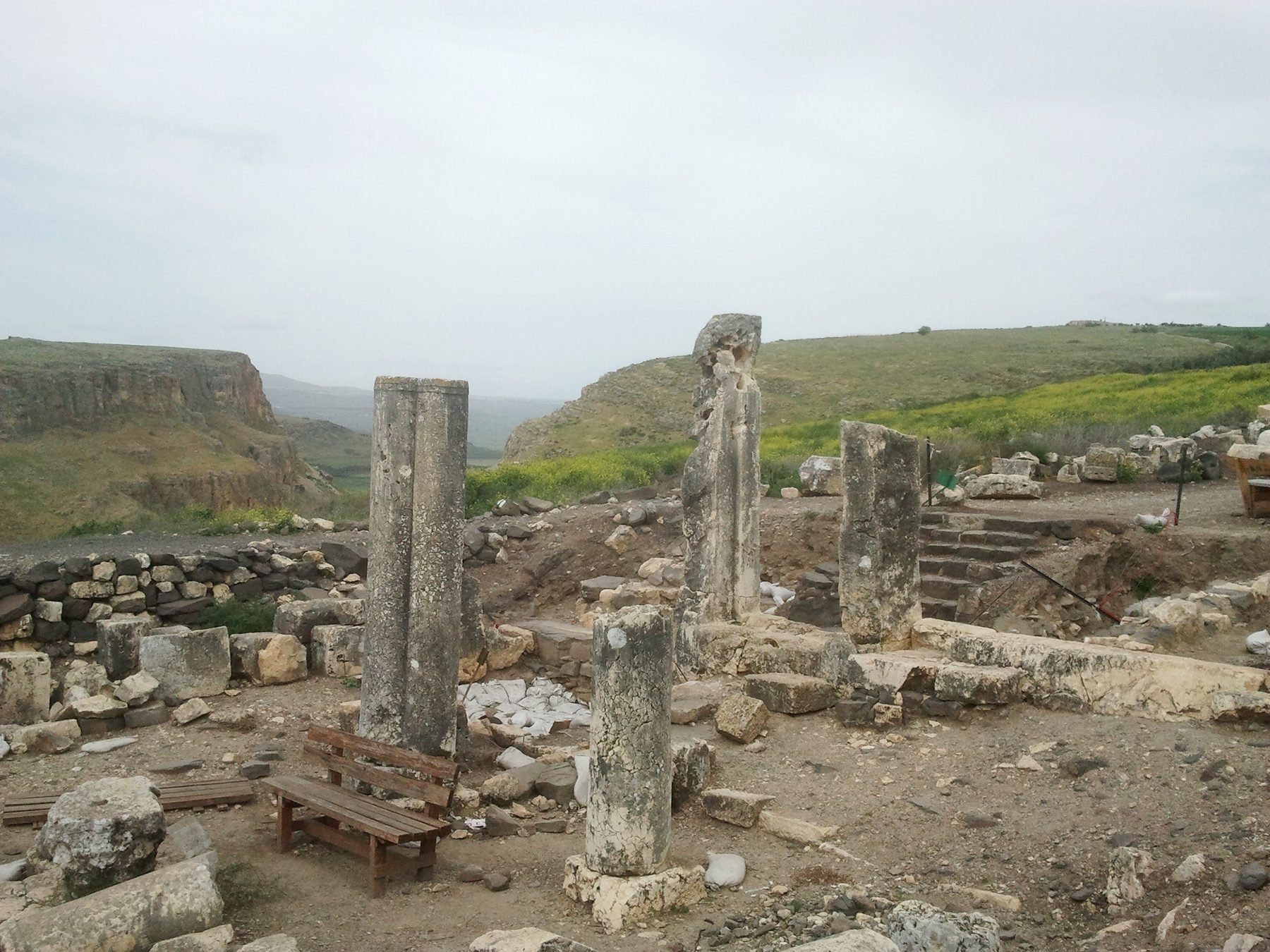
None of this is faded guesswork. The Hebrew labels on the zodiac signs and the seasons are legible, the ritual-object panel is unambiguous, and a dedicatory inscription names a benefactor associated with the floor's construction. The building itself is a basilical hall with rows of columns, oriented so that worshippers faced toward Jerusalem, with the mosaic running down the centre of the floor for the length of the room.
The zodiac floor at Hammath Tiberias
A mosaic pavement in the nave of an ancient synagogue at Hammat Tiberias, on the shore of the Sea of Galilee, showing a zodiac wheel with a central figure of Helios in his chariot, a surrounding ring of the twelve zodiac signs labelled in Hebrew, personifications of the four seasons in the corners, and a separate panel of Jewish ritual objects including a menorah. Dedicatory and identifying inscriptions appear in Hebrew and Greek. The mosaic remains in situ within the excavated remains of the synagogue.
In situ, Hammat Tiberias National Park, IsraelA pagan god on a synagogue floor
The obvious question is why a community that prayed toward Jerusalem and kept the images of its own ritual vessels on the same floor would also commission a Greco-Roman sun god at the centre of the room. Hammat Tiberias is not a lone eccentric case: comparable zodiac-wheel floors, with Helios or a solar image at the hub and the twelve signs and four seasons round it, have been found in other ancient synagogues in the region, including nearby sites in the Galilee and beyond. The pattern is consistent enough that it reads as a shared convention of the period rather than a one-off borrowing.
The standard reading treats the wheel as a calendrical and cosmological diagram rather than an act of sun worship: the zodiac signs correspond to the months of the Jewish year, the four seasons frame the annual cycle those months move through, and Helios at the centre stands for the sun itself, whose movement the Jewish calendar tracks and depends on to fix festivals in their proper season. On that reading the floor is closer to an illustrated almanac than to a devotional image, and its presence beside an unambiguously Jewish ritual panel, in a building oriented toward Jerusalem, is read as confirming that the congregation understood it as calendar, not cult.
Either way, the floor is hard evidence of something the biblical and rabbinic texts alone could not prove on their own: that Jewish communities in Roman and Byzantine Galilee were fluent participants in the wider visual culture of their world, borrowing its forms with confidence and putting them to their own use, in the most sacred room they had. A community anxious about the neighbours would not have laid a sun god at the centre of its own floor. This one did, and then put its menorah at the other end of the same room, in the same medium, with the same care.
Excavating Hammat Tiberias
The synagogue remains at Hammat Tiberias were uncovered through excavation campaigns across the twentieth century, revealing a sequence of successive synagogue buildings on the same site spanning several centuries. The zodiac-floor building is one identified phase within that sequence. Finds and the site itself are held and displayed by Israel's antiquities authorities, and the mosaic remains accessible in place at the national park that now protects it.
Israel Antiquities Authority; Hammat Tiberias National ParkFurther reading