The village Josephus names Gischala, and the modern map names Gush Halav or el-Jish, sits on a hillside in the Upper Galilee, a few kilometres from the Lebanese border. It is a small place to have earned a line in a war history, but it did: in the First Jewish-Roman War it was, according to Josephus, the last town in the Galilee to fall to the Roman advance. Centuries later, on the same hillside, the community built a synagogue - and carved an eagle into the stone above one of its doors. The building survives largely where it was raised. That, more than any single inscription, is the evidence: a working religious structure standing in a Jewish village that the Roman sources themselves record as defiant, still legible on the ground.
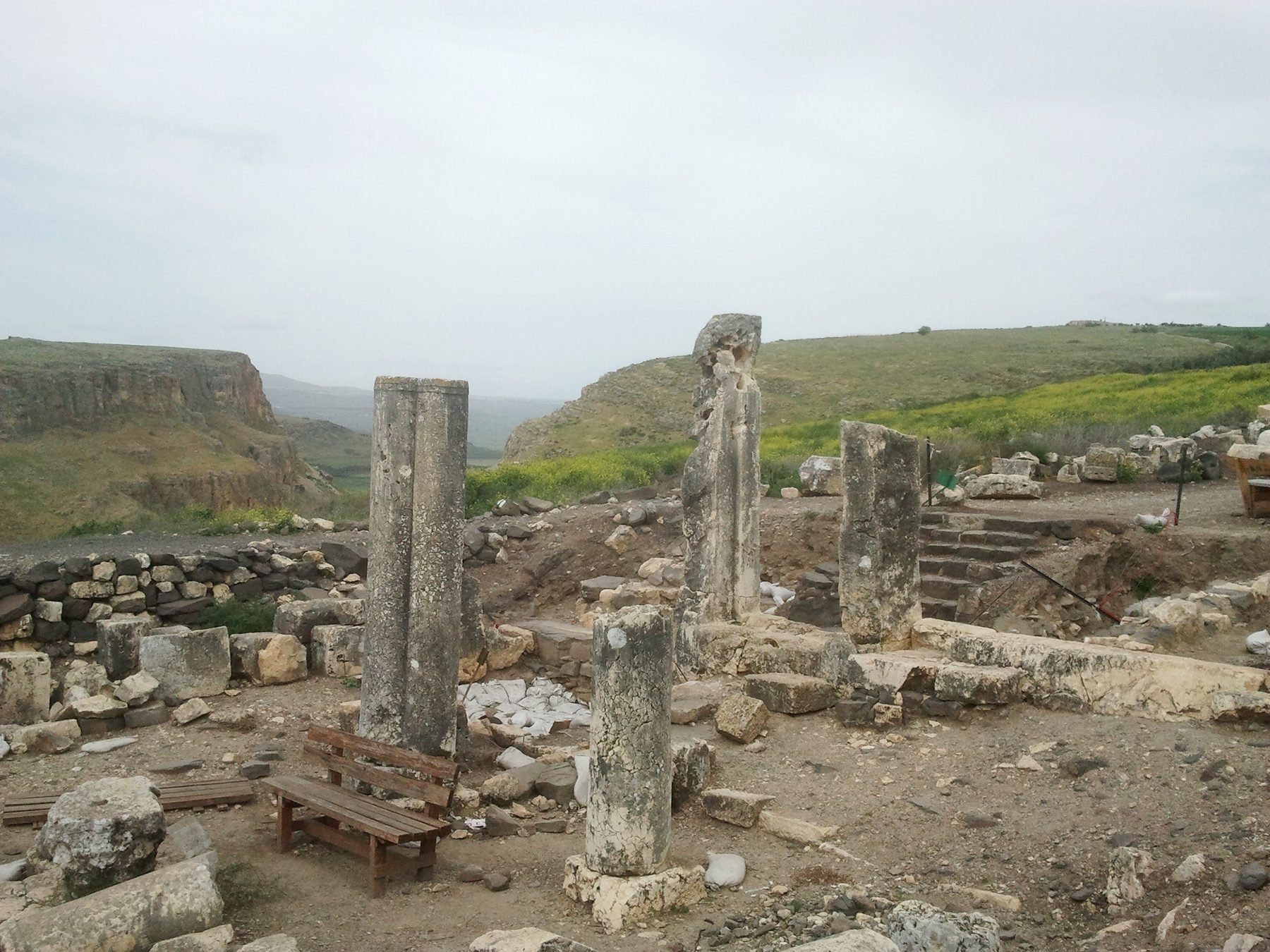
The synagogue is built of the local black basalt, in the style architectural historians call Galilean: a rectangular hall raised on a stepped foundation that follows the slope, with monumental doorways set into a decorated façade, colonnades inside dividing the hall into a nave and side aisles, and stone benches around the walls. It belongs to a family of buildings scattered across the Galilee and Golan - Capernaum, Chorazin, Bar'am among them - that share this vocabulary of carved lintels, columns and door frames, built for communities that plainly had both the means and the confidence to build large and build visibly.

A village that would not surrender quietly
Gischala's moment in the historical record comes from Josephus, who commanded Jewish forces in the Galilee at the start of the revolt against Rome and later wrote its history from the other side of the war. He names the town as the last Galilean stronghold to hold out, and names John of Gischala as its leader - a man who later slipped past the besieging Romans, made his way to Jerusalem, and became one of the factional commanders of the city's last defence before the Temple fell in 70 CE. Whatever one makes of Josephus as a witness to his own former comrades, on this point the war record and the geography agree: Gischala sat furthest from the main Roman line of march, in hill country that favoured resistance, and it was among the last places in the Galilee to be subdued.
None of that, by itself, proves anything about the synagogue built there generations later. What it establishes is the reputation the place carried into late antiquity: a Jewish village known, from a Roman-aligned source no less, for having fought rather than yielded. The synagogue is not evidence for the siege. It is evidence that the Jewish community at Gischala was still there afterwards, still organised, still building - the kind of continuity that a site's later archaeology can check even where its wartime drama cannot be independently confirmed.
Gischala's resistance
Josephus's account of the Jewish war against Rome identifies Gischala as the last Galilean town to resist, and names John of Gischala as its commander before John's later role in the defence of Jerusalem. The claim rests on a single ancient source, itself written by a former Jewish general turned Roman client, and modern readers weigh it with that in mind. The village's location - the Upper Galilee, farthest from the coastal roads the Roman army used - fits a town able to hold out longer than most.
Josephus, Jewish War; site at el-Jish, Upper GalileeFurther reading
The eagle over the door
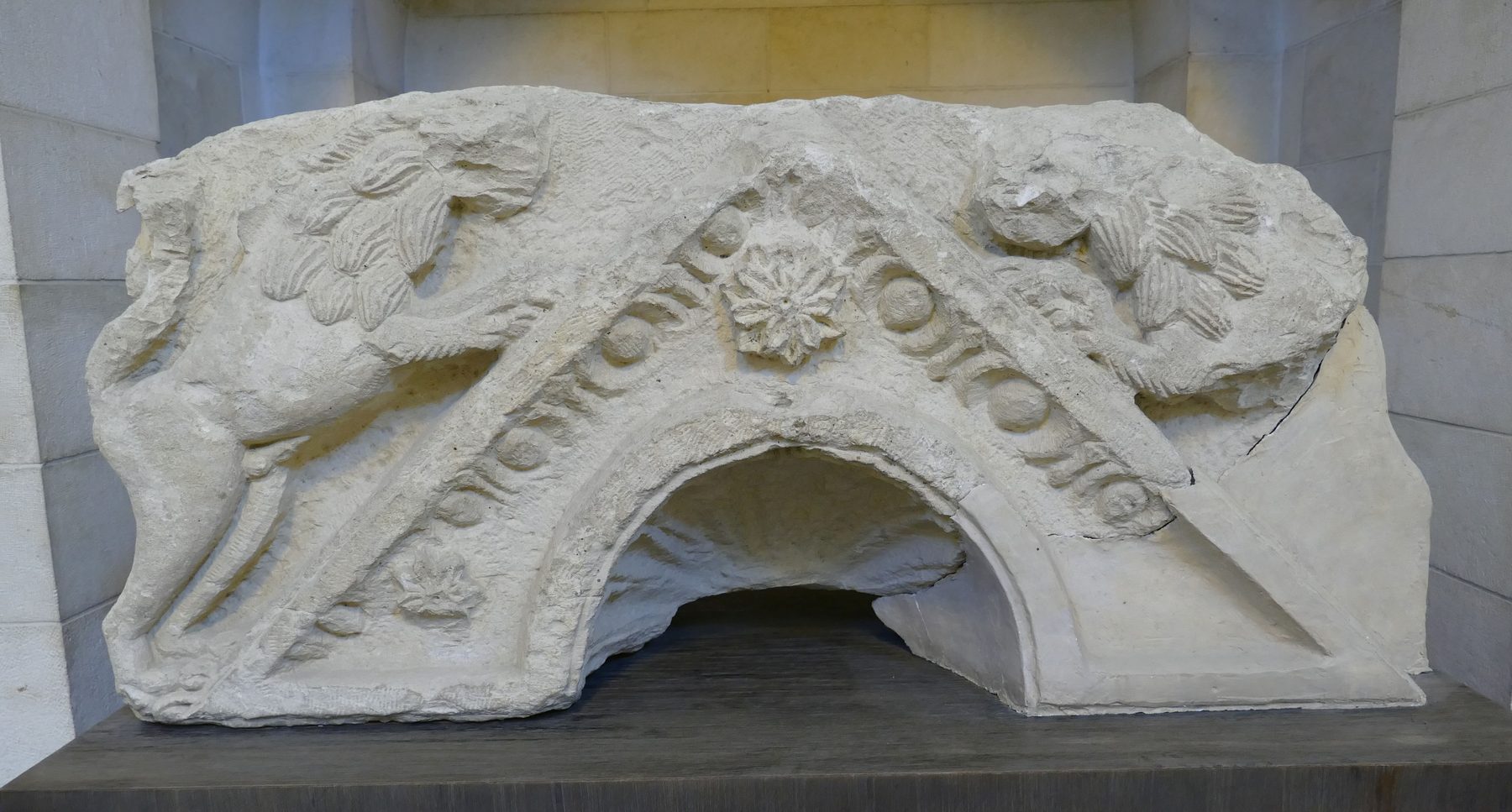
The synagogue itself dates to the centuries after that war, in the late Roman and Byzantine periods, when Galilean Jewish life rebuilt itself around exactly this kind of substantial communal building. Above one of its doorways the excavators found a carved relief of an eagle, wings spread, worked into the stone lintel in the same confident, public register as the columns and door frames around it. It is not a hidden or apologetic image. It sits over the threshold, where everyone entering the building would pass beneath it.
The eagle is not unique to Gush Halav. Related synagogues elsewhere in the Galilee and Golan carry their own decorative animal and floral motifs on lintels and friezes, and the eagle in particular was one of the most recognisable images in the Roman visual world, a mark of imperial and civic authority as much as a natural creature. That overlap is exactly what makes the image interesting rather than incidental, and exactly what scholars still argue about. One line of interpretation treats the eagle as a purely decorative or architectural motif, borrowed from the wider Roman-period vocabulary of stone carving without any specific theological weight. Another asks harder questions about it: whether such images sat comfortably alongside the biblical prohibition on graven images, whether local communities read the same law differently in different periods, or whether an eagle on a lintel was understood less as an idol than as ornament, the way a Roman-period Jewish community might use a widely shared visual language without adopting its religious meaning. No consensus settles the question, and the debate is really a debate about how strictly and how uniformly the prohibition on images was observed across the ancient synagogues of the Galilee - a live argument, not a solved one.
What is not in dispute is what the building itself demonstrates. A synagogue of this scale, built and used over a long stretch of late antiquity, in a village the Roman-era sources themselves marked out as stubbornly Jewish, is direct physical evidence for organised, prosperous, visible Jewish communal life in the Galilee long after the Temple fell and the war was lost. The building did not need to survive as a ruin to make that case; it needed only to have been built at all, in stone, by people willing to put their own image of a public bird over their own front door.
The Galilean-type synagogue at Gush Halav
Built in basalt on a stepped hillside foundation, the synagogue follows the broad Galilean-type plan shared with sites such as Capernaum, Chorazin and Bar'am: a colonnaded hall, monumental decorated doorways, and stone benches. A relief of an eagle survives on the lintel of one doorway. The building remains in situ at el-Jish and has been studied through archaeological excavation rather than through any surviving inscription naming its builders or date with precision.
In situ, el-Jish, Upper GalileeFurther reading
The village Rome recorded as the last to surrender is the same village whose synagogue still stands. The stone did not need to argue the point. It only needed to be built.