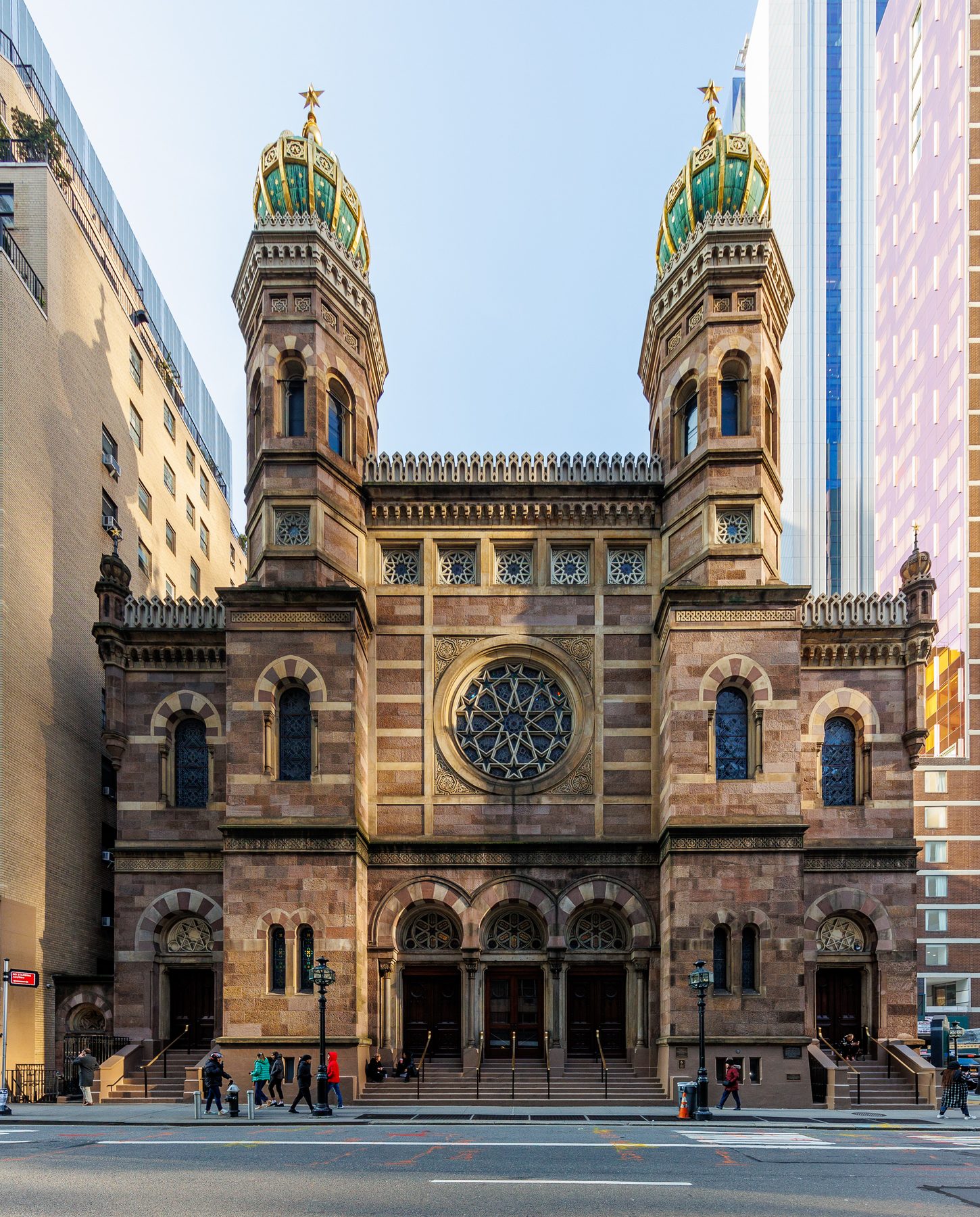
On Elizabeth Street, facing Hyde Park in the middle of Sydney, stands a building that does not apologise for its size. The Great Synagogue was built to look like what it is: a cathedral-scaled house of worship, raised by a colonial Jewish community confident enough to put its largest, most public statement on one of the city's grandest streets rather than tuck it away. The building itself is the evidence. It proves not that Jews were present in early Sydney - other, humbler records do that - but that by the 1870s they were established, organised and prosperous enough to build permanently, monumentally and in the open.
Jewish presence in the colony goes back to the First Fleet of 1788, which carried a number of convicts of Jewish birth among its cargo of the transported. Free Jewish settlement followed through the early nineteenth century, and the community outgrew a series of earlier, smaller synagogues before commissioning the building that stands today. The Great Synagogue is not the first Sydney synagogue. It is the one built once the congregation had decided it was staying.

What the stone shows
The congregation held a design competition for the new building, and the commission went to the colonial architect Thomas Rowe, who also designed Sydney Hospital and a run of the city's other major nineteenth-century public buildings. His synagogue is worked in sandstone in a Byzantine and Gothic revival idiom common to grand Victorian-era religious architecture across the British Empire, with little on the exterior that marks it as specifically Jewish beyond its purpose. That restraint is itself informative: the building speaks the same civic architectural language as the churches and public halls around it, built by the same generation of colonial architects, for a community that intended to be read as part of the city's establishment rather than apart from it.
Inside, the plan follows an orthodox synagogue's requirements - an ark for the Torah scrolls on the wall facing Jerusalem, a raised platform for the reading of the Torah, and a gallery for separate seating - built at a scale that matches a cathedral rather than a chapel. The building has functioned continuously as a working synagogue since its consecration, which makes it not only a monument but a live record: the same room in which services were held in the 1870s is the room in which the congregation still prays.
Foundation stone to consecration
The foundation stone was laid in the mid-1870s and the completed building was consecrated in 1878, following a design competition won by the architect Thomas Rowe. It replaced a series of earlier, smaller Sydney synagogues, including a York Street congregation dating to the 1840s, as the community's numbers and confidence outgrew what had come before.
Elizabeth Street, SydneyWhy a building counts as evidence
A synagogue this size, built this early, in a city this young, corroborates something that written accounts alone can suggest but not fix in place: that the colonial Jewish community of Sydney was not a scattering of individuals passing through but an organised body with the numbers, the money and the institutional confidence to commission a landmark. Congregations do not raise cathedral-scaled buildings on their principal streets on a whim, and they do not do it while still uncertain of their own permanence. The building is a decision made in stone about how the community understood itself in 1878, and that decision has been legible on Elizabeth Street ever since.
The building also matters as continuity evidence in a narrower sense. Congregations move, buildings are repurposed, and synagogues in many diaspora cities have passed out of Jewish hands entirely, becoming churches, warehouses or ruins. The Great Synagogue has not. It has held the same congregation, on the same site, without interruption, since consecration - a continuity that is unusual enough, over a century and a half in any diaspora setting, to be worth stating plainly rather than taking for granted.
From First Fleet to cathedral synagogue
Jewish convicts arrived with the First Fleet in 1788, and free Jewish settlement in the colony grew through the early nineteenth century, supporting a succession of Sydney synagogues before the Great Synagogue was built. The building today stands as a heritage-recognised landmark of the city and remains an active orthodox congregation, making it a continuous physical link between the colony's earliest Jewish arrivals and the present community.
Great Synagogue congregation, SydneyFurther reading