A synagogue this size did not exist for most of Jewish history, and that absence is itself the fact worth starting from. For nineteen centuries after the destruction of the Second Temple, the tribe's houses of prayer were built small, tucked into courtyards and side streets, sized to a community that could never assume it would be left alone to build big. The Great Synagogue of Jerusalem, on King George Street in the centre of the modern city, is the opposite kind of building. It is a state-scaled sanctuary, deliberately monumental, raised by a sovereign Jewish capital that had, for the first time since antiquity, both the standing and the intention to build a central synagogue the way other capitals build cathedrals. The building is the evidence. What it proves is not a text or an inscription but a fact of scale: a return of confidence large enough to be poured in stone.
The synagogue sits beside Heichal Shlomo, the domed building that for decades housed the Chief Rabbinate of Israel and now holds the Wolfson Museum of Jewish Art. The pairing is not incidental. Israel's Chief Rabbinate, established under the British Mandate and continued by the state, needed a seat and, eventually, a sanctuary to match it - a synagogue capable of hosting state occasions, the swearing-in of chief rabbis, and the ordinary Shabbat and festival prayer of a large Jerusalem congregation, all in one hall. Construction of the synagogue itself took years, funded through public and philanthropic subscription in the way large communal buildings usually are, and the building was consecrated in 1982. The gap between the state's founding in 1948 and the synagogue's completion over three decades later is itself part of the record: monumental building follows confidence, and confidence took time to accumulate even after sovereignty was declared.
What the building argues
A synagogue is not, in Jewish law or practice, required to be large. The requirement is a minyan, a quorum of ten, and history is full of dignified prayer held in rooms far smaller than this one. So when a community builds monumentally, it is arguing something beyond the requirements of the ritual - and what the Great Synagogue argues, sitting where it does, is continuity of the highest possible register. It occupies, in the civic geography of the new capital, something like the place a national cathedral occupies elsewhere: the building state ceremony reaches for when it wants a religious register grand enough to match the occasion, without ever claiming to replace the Temple whose absence still structures Jewish liturgy. The synagogue does not pretend to be the Temple. Its very existence, on a street named for a British king in a city held by a Jewish state, is itself the more interesting claim: that ordinary sovereignty, the unglamorous kind that pays architects and lays foundations, had finally arrived to a people who had spent nineteen centuries praying toward a Temple Mount they could not build on.
The building's use bears this out. It has hosted state and communal occasions tied to the Chief Rabbinate and to the wider civic life of the capital, functioning as Jerusalem's closest equivalent to a central synagogue even though - by design, in a religiously plural and largely voluntary system - no single building can claim that title formally. Scholarly and communal writing about the synagogue tends to treat it less as a monument to a single architectural idea than as a working answer to an administrative and civic need: a capital city, once it has a government, a parliament and a supreme court, eventually also builds itself a synagogue equal to the rest.
From capital to sanctuary
Jerusalem became the seat of the new Israeli government from 1948, and the Chief Rabbinate of Israel, continuing an office established under the Mandate, was based nearby at Heichal Shlomo from the 1950s. The adjoining Great Synagogue was built over the following decades and consecrated in 1982, giving the Rabbinate and the capital a state-scaled sanctuary for the first time since the Second Temple's destruction in 70 CE.
King George Street, Jerusalem - in situReading the scale
What makes the Great Synagogue worth treating as evidence, rather than simply as a large and handsome building, is the comparison it invites with everything that came before it. Diaspora synagogues, for most of the last two thousand years, were built to be defensible or inconspicuous, sized to congregations who could not assume permanence and often could not build above the height of the surrounding churches or mosques without special permission. A synagogue on a main boulevard of a Jewish capital, built to full civic scale, without a permission slip from anyone, is a different kind of object entirely. It does not need to say what it proves. It only needs to be measured against what could not have stood, in this form, on this street, at any earlier point in the story - and the measurement does the rest of the work.
One synagogue among several, and still unusual
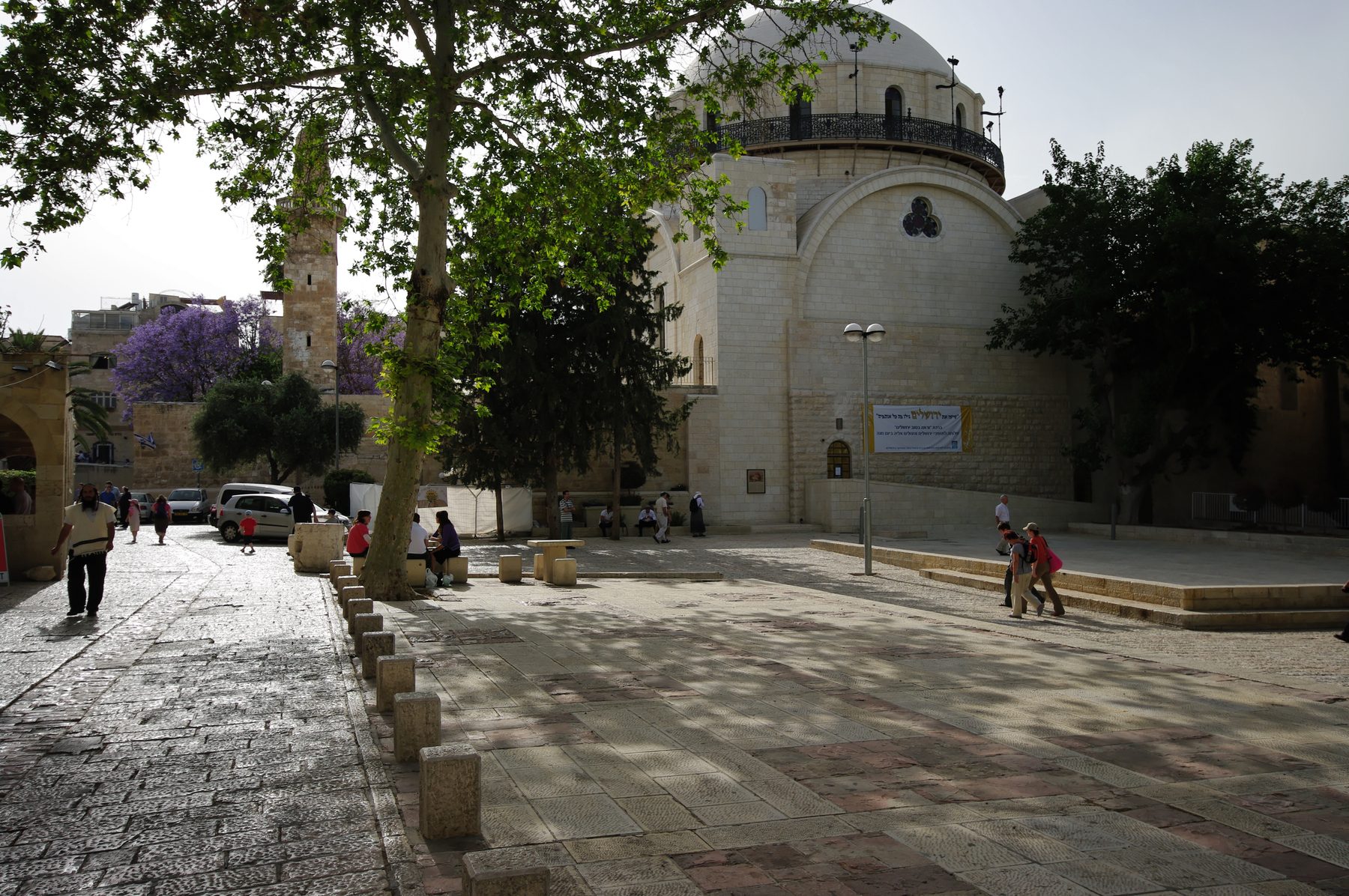
Jerusalem has no shortage of large and historic synagogues - the Hurva in the Old City, rebuilt and reconsecrated in 2010 after standing in ruins for over four decades, and Yeshurun on King George Street among them. The Great Synagogue's distinction is not size alone but its civic pairing with the Chief Rabbinate's seat, which places it, functionally if not formally, at the intersection of religious and state life in the capital.
Comparative context, Jerusalem synagoguesFurther reading