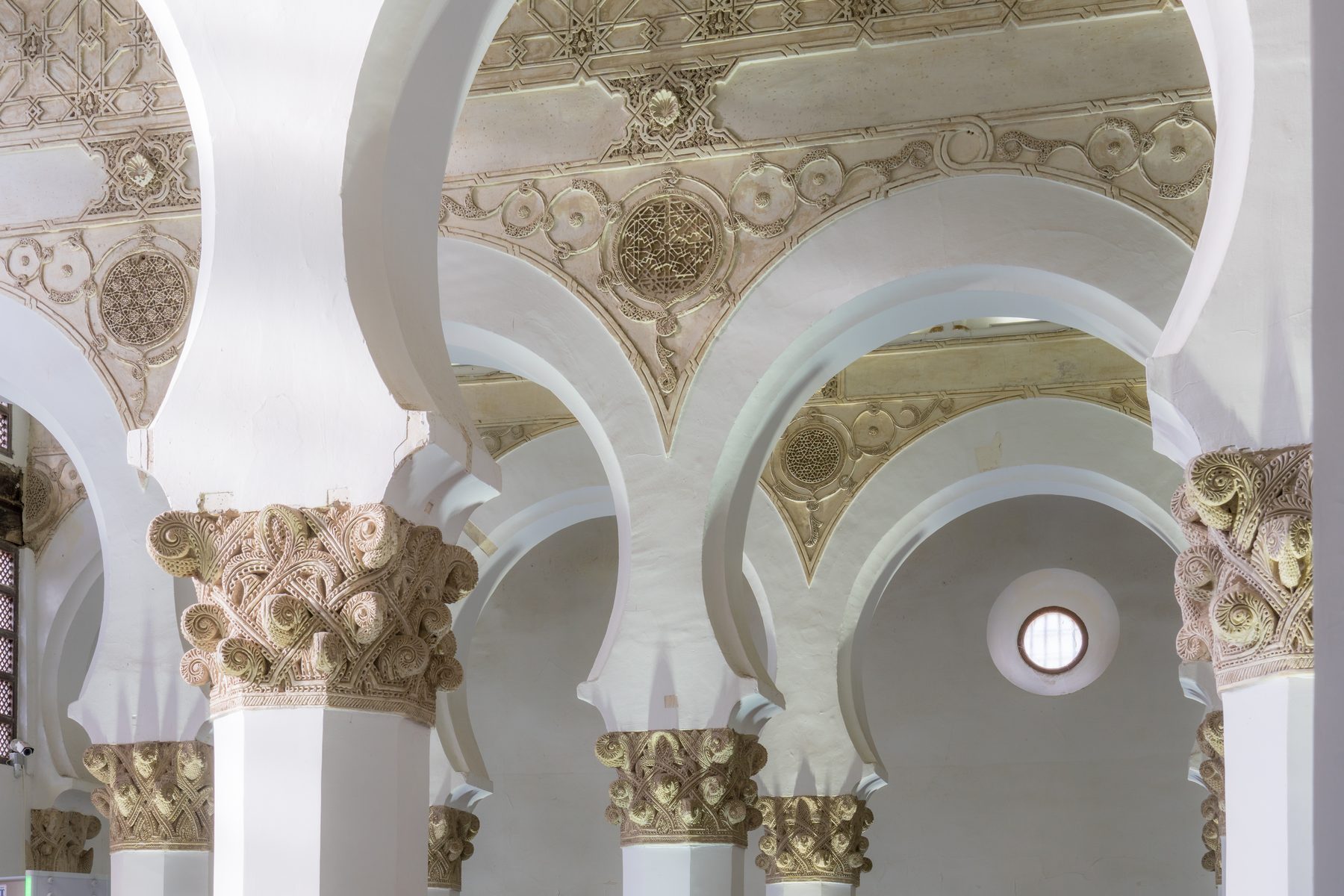
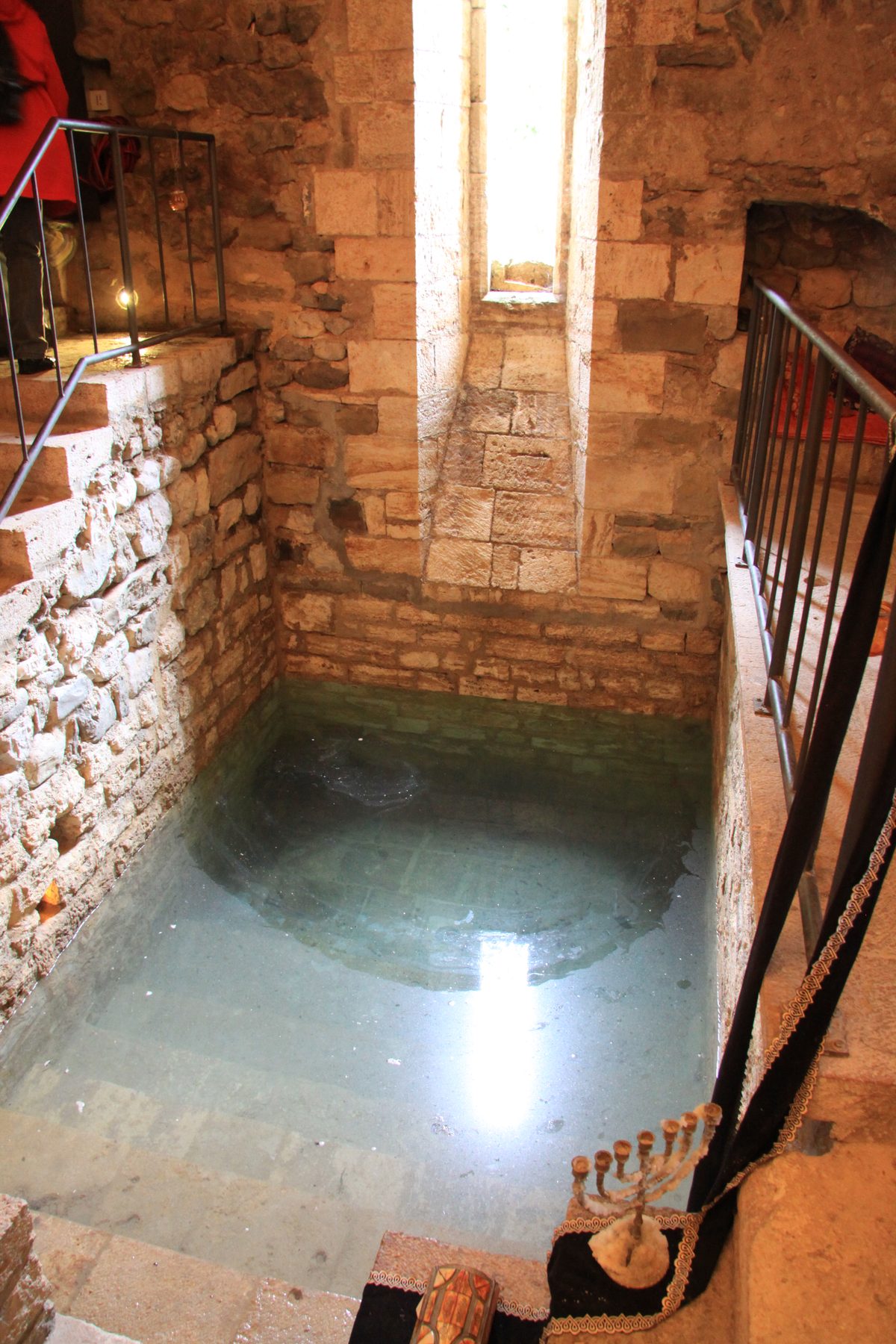
Aleppo's Jewish community was old, prosperous and confident enough to build its main synagogue not as a single hall but as a compound: courtyards opening onto one another, a women's section, study rooms, and at its heart a cave-like grotto cut into the rock beneath the building. Local tradition connects the site to a much older place of prayer, and the congregation itself was known by a name recalling ancient Aram - Aram Tzova. Whatever the precise age of the earliest structure, the compound as it stood into the twentieth century was the product of many building phases, additions and repairs stacked over a very long span of use. That layering is itself part of the evidence: a community rebuilding on the same footprint for centuries is a community that never left.
The building is also known as the Bandara Synagogue, sited in the old Jewish quarter of Aleppo. Its fame beyond the city rests on what it held rather than on its architecture alone: for centuries the community kept, in an iron chest inside the grotto, the manuscript known as the Crown of Aleppo - Keter Aram Tzova - a bound codex of the complete Hebrew Bible written with its vowel points, cantillation marks and Masoretic notes by scribes working in the tenth century CE. It is one of the earliest and most authoritative complete Hebrew Bible manuscripts to survive, and the synagogue that sheltered it is itself part of the record of how that survival happened.

What the building and the manuscript together show
Read separately, a synagogue compound and a bound manuscript are two different kinds of evidence. Read together, they show something neither shows alone: an unbroken chain of physical custody. The codex was not kept in a museum vault or a royal library. It was kept in a working synagogue, in a cave-like recess adapted for the task, guarded by a living community that prayed in the rooms around it for generations. Scholars who wished to consult the manuscript's authoritative text - to settle a question of spelling, cantillation or the exact wording of a verse - travelled to Aleppo to see it in place, and the tradition that it should not leave the synagogue held for the better part of six hundred years.
That custody ended abruptly. In December 1947, in the days after the United Nations vote on the partition of Palestine, a mob set fire to the synagogue and to much of the Jewish quarter around it. The building was badly damaged and the manuscript was, for a time, believed destroyed along with it. It was not destroyed. Members of the community had managed to remove it from the burning building, and after some years in hiding it was smuggled out of Syria in 1957 and brought to Israel, where it was presented to the state and eventually placed with the Israel Museum. When it was finally examined there, a large portion of the original leaves - roughly the Torah section and other passages - were found to be missing, lost either in the fire itself or at some point during the years the codex was concealed. What survives is still the closest thing scholars have to the authoritative Masoretic text in its original medieval form.
The Great Synagogue of Aleppo
A synagogue compound in the old Jewish quarter of Aleppo, also known as the Bandara Synagogue, built up in successive phases around a grotto cut into the rock. It served as the seat of the Aleppo Jewish community for centuries and, from some point in the medieval period, as the repository of the Crown of Aleppo. The building was set on fire during anti-Jewish riots in December 1947 and badly damaged; parts of the historic compound have since been restored.
Old Jewish quarter, AleppoWhy a building counts as evidence
It would be easy to treat the Crown of Aleppo purely as a text and leave the synagogue itself to one side as backdrop. That misses what the building actually proves. A manuscript's authority rests partly on its content and partly on the credibility of its chain of custody: who kept it, where, under what conditions, and for how long. The Great Synagogue of Aleppo is the physical answer to that question for six centuries running. Its courtyards, rebuilt again and again on the same ground, and its grotto, fitted to hold an iron chest, are the evidence that the story of custody is true - a named place, a named community, an unbroken tenancy that the photographic record and the testimony of those who carried the manuscript out of the fire both confirm.
From Aleppo to Jerusalem
Following the 1947 fire, the surviving portion of the Crown of Aleppo was kept hidden within the community before being smuggled out of Syria in 1957 and brought to Israel. It was subsequently placed in the custody of what is now the Israel Museum in Jerusalem, where the surviving leaves are held, studied and periodically exhibited, and where the extent of the missing portion has been documented against earlier descriptions and partial transcriptions of the complete manuscript.
Israel Museum, JerusalemFurther reading