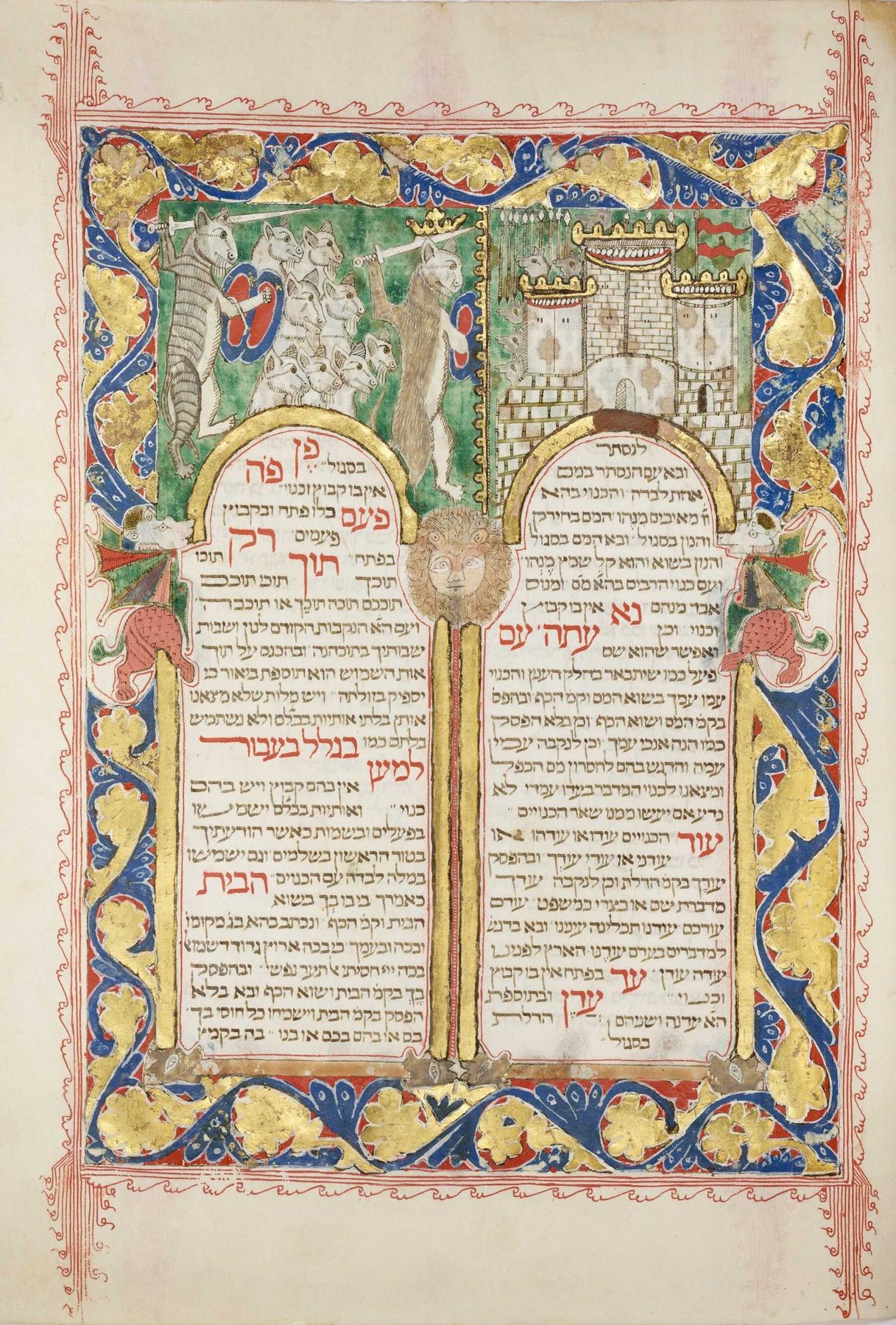
Open the Golden Haggadah and the text of the Passover service does not come first. Fourteen pages of full-page miniatures do - framed scenes from Genesis and Exodus, each figure set against a burnished sheet of gold leaf that catches candlelight the way no ink can. Only after that picture cycle does the familiar liturgy begin: the Four Questions, the plagues, the songs sung at the end of the Seder. The manuscript was made to be read at a table, on one night a year, by a family wealthy enough to commission it and confident enough to fill it with human figures at a moment when some rabbinic opinion was uneasy about exactly that.
It survives complete, its gold grounds largely undimmed, in a British institution thousands of miles and several centuries removed from the Barcelona workshop that most likely produced it. That survival is itself a kind of evidence: of the wealth and taste of Sephardic Jewish patrons before the expulsion of 1492, of the artistic networks that connected Jewish and Christian workshops in Crown of Aragon territory, and of how such an object could pass through Christian, and eventually British, hands and still be legible today as what it always was - a Jewish book made for a Jewish home.

What the book is
A Haggadah is the text read at the Passover Seder: the retelling of the Exodus from Egypt, structured around ritual foods, questions asked by the youngest child present, and songs of praise. Haggadot circulated for centuries as sections within larger prayer books before becoming independent volumes in their own right, and the fourteenth century in Spain produced some of the most lavishly illustrated examples to survive from anywhere in the medieval Jewish world. The Golden Haggadah belongs to that group: a small cluster of related Catalan manuscripts, sharing a similar picture-cycle format, that scholars sometimes discuss together because of how closely their compositions echo one another.
Its miniatures run in horizontal registers, generally two scenes to a page, moving from the Creation and the story of the Patriarchs through to the Exodus itself, before the Hebrew text of the Haggadah proper begins. The figures are drawn with the elegant, elongated style found across Gothic manuscript painting of the period, and the gold backgrounds behind them were laid down and burnished by the same techniques used in contemporary Latin devotional books - a strong sign that the artists who worked on Jewish commissions of this kind were trained in, or shared workshops with, the wider Christian manuscript trade of Catalonia.
The Golden Haggadah (Add. MS 27210)
An illuminated Hebrew manuscript on parchment, containing the Passover Haggadah preceded by fourteen pages of full-page biblical miniatures set on burnished gold grounds. Produced, most likely, in Catalonia in the early to mid-fourteenth century, for a Jewish household able to commission work of this quality. It survived the 1492 expulsion of the Jews from Spain and later passed into British hands, entering the national collection in the nineteenth century. It is now held by the British Library in London and has been digitised for public viewing.
British Library, LondonWhere and when it was made
Nothing in the manuscript states outright where it was written, and no colophon records a scribe's name or a precise year. The dating and localisation rest on the style of the illumination - the drapery, the palette, the treatment of faces and architecture - compared against dated and located Christian manuscripts from the same Catalan workshops. That comparison points firmly to Barcelona or its immediate region in the first half of the fourteenth century, a period when the city held one of the larger and more prosperous Jewish communities in the Crown of Aragon, before pressure on Spanish Jewry intensified later in the century.
How the book left Spain is not recorded in any surviving document attached to it. Spanish Jews were expelled by royal edict in 1492, and manuscripts of this kind travelled with refugee families, through later owners, and eventually into the European manuscript trade, by routes that in most cases cannot now be reconstructed in full. What can be said with confidence is where the trail becomes documented: the volume entered the British Museum's collection in the nineteenth century and has remained in Britain, under the British Library since the library separated from the Museum in 1973, ever since.
The picture cycle itself is part of what makes the manuscript useful as evidence. It shows, in concrete visual form, that a Jewish family in fourteenth-century Catalonia could commission a book depicting human and even divine action in narrative scenes - a practice sometimes assumed, wrongly, to have been foreign to medieval Jewish art. The Golden Haggadah, alongside its sister manuscripts, demonstrates the opposite: an illustrated tradition confident enough to stand alongside, and share craftsmen with, the Christian devotional manuscripts of the same city.
Further reading
The gold-ground miniature cycle
Fourteen full pages of paired biblical scenes, from the Creation through the Exodus, each figure painted against a burnished gold-leaf ground, precede the Hebrew liturgical text. The cycle is placed before the Haggadah text rather than interleaved within it - a picture-book prefacing a prayer-book, a structure shared with several other Catalan Haggadot of the same century. The technique of laying and burnishing gold leaf under painted figures mirrors methods used in contemporary Christian devotional manuscripts produced in the same region.
British Library, London - Add. MS 27210