Climb the Carrer de la Força in Girona and the street narrows, steepens and begins to fold back on itself in a maze of stepped stone lanes that no planner would design and no army would want to fight through. This is the Call, the city's old Jewish quarter, and it has survived not because anyone preserved it on purpose but because, for centuries after the community that built it was gone, nobody bothered to knock it down. That accident of neglect is now the evidence. Girona's Call is one of the best-kept medieval Jewish quarters in Europe, and it can be walked, measured and read as a document in stone.
The word itself is a clue. Call is Catalan for a Jewish quarter, and it comes from the Hebrew qahal, meaning community or congregation. The quarter took its name from the people who lived there, not from any feature of the buildings, and the name stuck to the streets long after the people were forced to leave them.

A community documented for centuries
Jews are attested in Girona from the early medieval period, and by the later Middle Ages the community was among the more important in Catalonia, with its own institutions, courts and cemetery on the hill of Montjuïc above the city. Girona was also a centre of early Kabbalah: a circle of mystics active there in the thirteenth century helped shape the tradition that would later flower in works such as the Zohar, and the city's most famous son, the rabbi and physician known by his Catalan name Bonastruc ça Porta - Moses ben Nahman, or Nahmanides - was born in Girona and became one of the most influential Jewish scholars of the age. None of that is legend dressed as fact. It is drawn from surviving documents, and it is the reason the Call was worth building as densely and as permanently as it was.
The 1492 expulsion of the Jews from the kingdoms of Spain emptied the Call within months. Some residents left for other lands; others converted rather than go. The buildings did not vanish - they were reassigned, subdivided and built over, absorbed so thoroughly into the fabric of Christian Girona that for a long stretch of the city's history few residents would have known a synagogue and a study hall lay behind the plaster of the houses they passed every day.
The Call as physical evidence
The street plan of the Call - narrow, stepped, turning sharply, built up rather than out - is itself a record of a community housed within a fixed, crowded perimeter for generations. Excavation and restoration work in the quarter through the later twentieth century uncovered structures including a former synagogue site, later study rooms and courtyards, now presented together as the Museum of Jewish History of Girona. The building fabric corroborates what the documents say about a settled, institutionally organised community occupying this ground for centuries, not a scattered or transient population.
In situ, the Call, GironaWhat came out of the walls
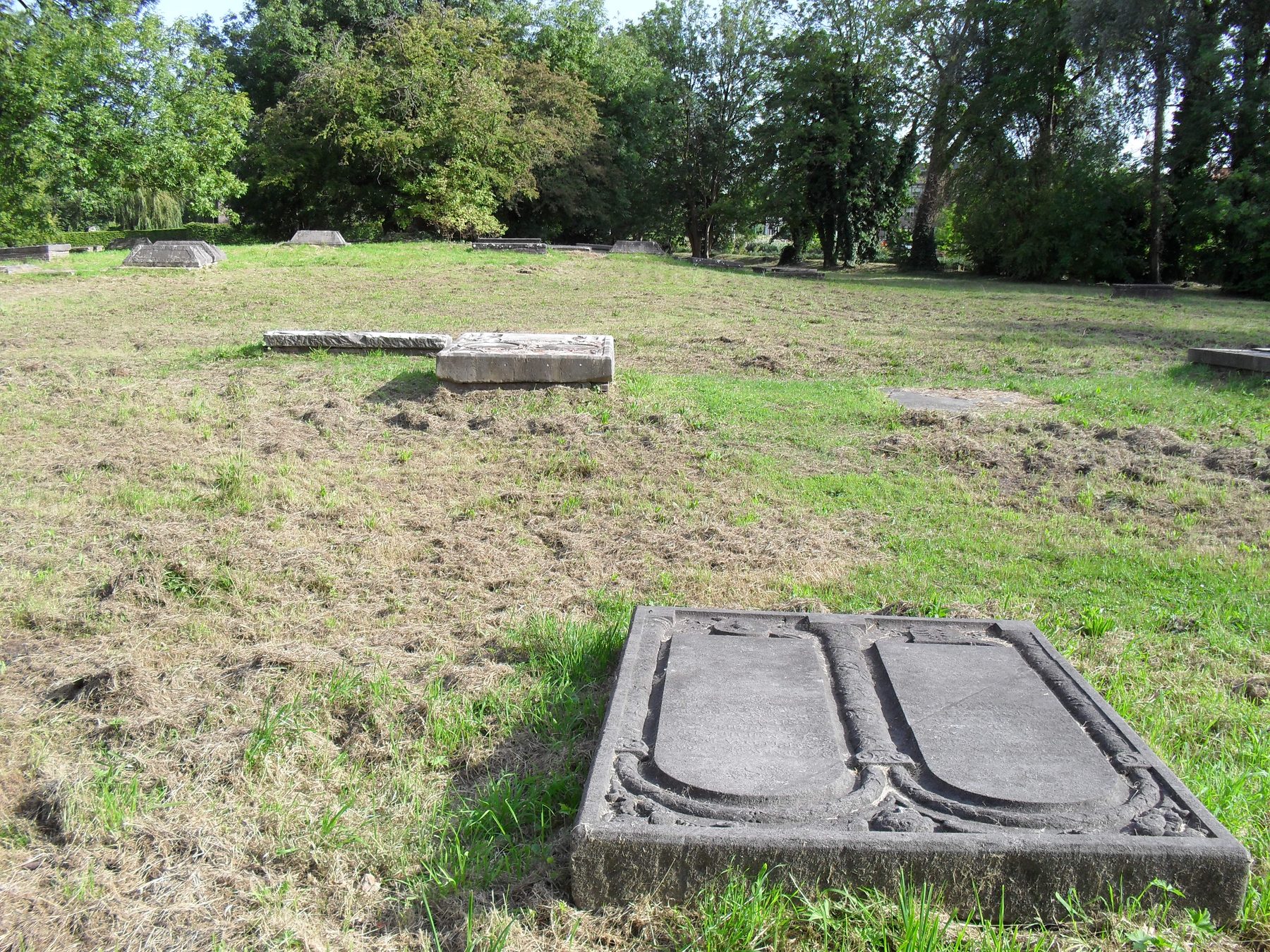
The most direct evidence did not come from the Call's houses but from Girona's city walls and from later buildings elsewhere in the town. After 1492 the Jewish cemetery on Montjuïc was cleared, and its inscribed headstones - carved in Hebrew, recording names and dates in the traditional formulas of Jewish burial - were broken up and reused as ordinary building stone in walls and foundations around the city. For centuries they sat there anonymously, doing structural work, their inscriptions facing inward or lost under mortar. Restoration and archaeological work over the past century has identified a number of these stones and recovered them, and several are now on display. A tombstone does not lie about who put it there. Each recovered fragment is a small, checkable proof that a Hebrew-literate community buried its dead in this city, in this period, according to its own customs - not narrative, just stone doing what stone does.
Hebrew tombstones reused as building stone
Headstones from the Jewish cemetery of Montjuïc, carved in Hebrew with names and dates in standard funerary formulas, were broken up after the community's expulsion and built into city walls and other structures as plain masonry. Identified and recovered through restoration work, a number are now conserved and displayed in Girona, where their inscriptions can be read directly rather than taken on trust.
Museum of Jewish History of GironaTaken together, the street plan and the salvaged stones make the same case from two directions. The Call proves that a Jewish community in Girona was substantial enough, and settled enough, to build a dense quarter of its own within the city walls and maintain it for generations. The tombstones prove that this same community buried its dead in Hebrew, according to its own law, right up until the expulsion forced it out. Neither fact depends on a chronicle's word for it. Both can be walked to, or read directly off the stone, by anyone who climbs the Força today.
A tombstone does not lie about who put it there. It only waits to be turned back around.
Further reading