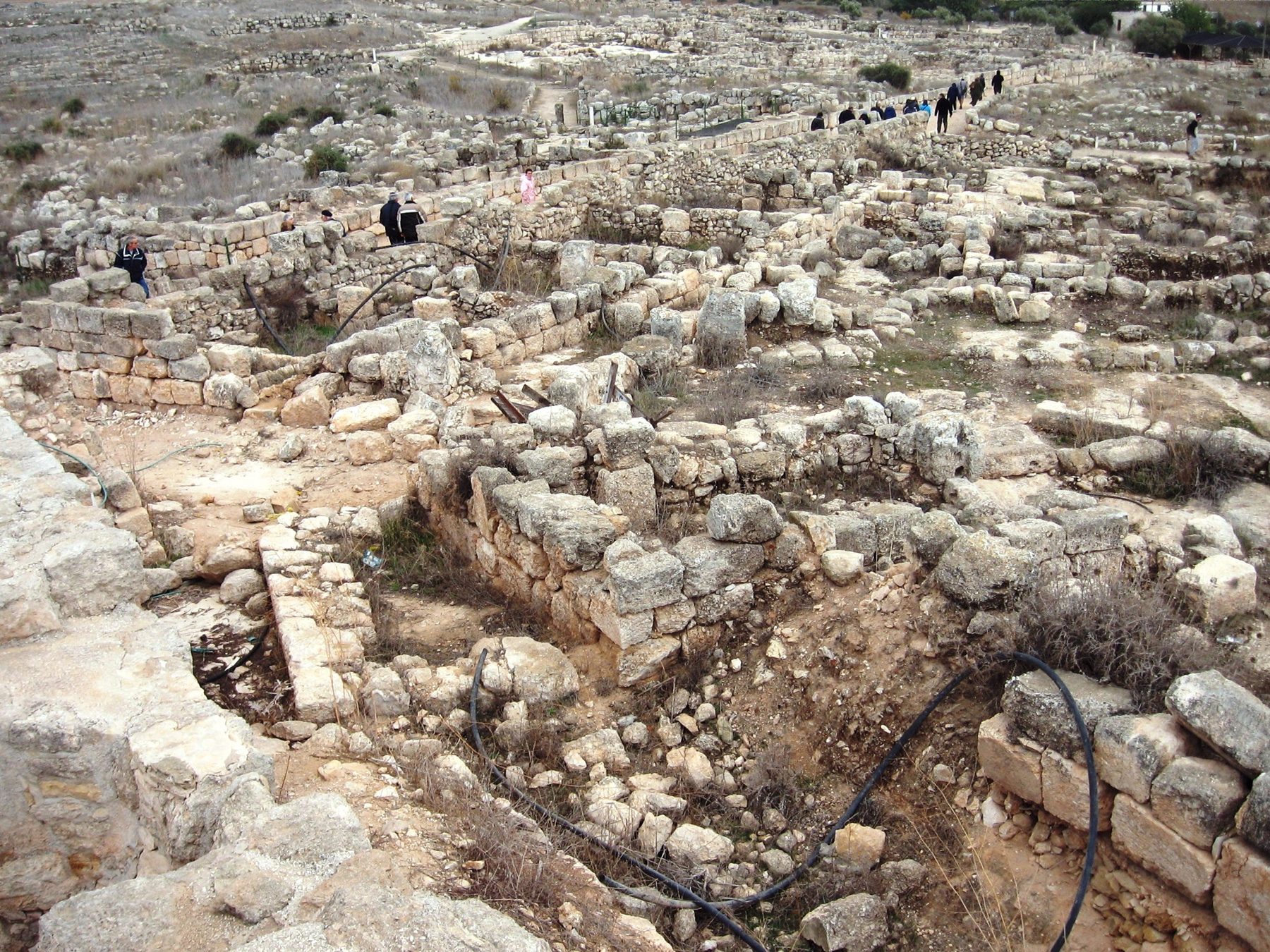
The village of Samu, in the southern Hebron hills, sits on a low rise of biblical Eshtemoa - a town the Book of Joshua lists among the settlements given to the priestly line of Aaron. Somewhere beneath and beside the modern houses, a large ancient building has stood, in whole or in part, above ground for something like a millennium and a half. It is built of massive dressed stone, its outer walls thick enough to carry weight without any internal columns, and its long axis runs so that anyone standing inside it faced towards Jerusalem. It is a synagogue, and it is one of the rare ones from this period that was never entirely lost to memory - villagers going back generations knew the site as a holy building even before any excavation confirmed what it was.
What makes Eshtemoa worth a stop is not size alone. Synagogues of the same broad late antique period survive across the Galilee and the Golan in far greater numbers, many of them grander. Eshtemoa belongs to a smaller, harder group: the synagogues of Judea proper, in the hill country south of Jerusalem, built by communities that stayed in the Judean heartland after the Roman suppression of the Bar Kokhba revolt rather than concentrating, as so much of the story does, in the Galilee. A working synagogue standing in Judea itself, this far south, this well preserved, is a rarer kind of evidence than its size would suggest.

A hall without columns
Most large public halls of the ancient Mediterranean world, synagogues included, needed internal columns to support a wide roof - the basilical synagogues of the Galilee, with their rows of columns dividing the hall into a nave and aisles, are built this way. Eshtemoa is not. Its walls are built of large, well-dressed stone blocks, thick enough to bear the roof load on their own, leaving the interior open. The effect, for a worshipper standing inside, would have been a single unbroken room rather than a colonnaded hall - a plainer, heavier kind of architecture, built to last on mass rather than engineering cleverness.
The entrance was set in the long northern wall, and the hall was oriented so that the short wall opposite, on the building's southern or south-western side, faced towards Jerusalem - the direction Jewish prayer in this period was already fixed toward. A niche or focal point along that wall would have held the community's Torah shrine, the element every synagogue of the period organised its interior around, whatever form the building otherwise took. The plan is simple to describe and expensive to build: this was a community investing serious labour and stone in a permanent house of prayer, not a converted room.
The Eshtemoa Synagogue Building
A broadhouse-plan synagogue built of large dressed stone blocks, standing without internal columns, at the site of biblical Eshtemoa in the modern village of Samu, southern Hebron hills. The hall was entered on its long northern side and oriented towards Jerusalem, with a focal wall opposite the entrance where the Torah shrine would have stood. The building's massive construction has allowed substantial portions of its walls to survive above ground into the modern period, incorporated into and beside later village structures. It is generally dated to the Late Roman or Byzantine period, within the wider horizon of Judean and Galilean synagogue building of late antiquity.
Judea after the revolt
The wider reason Eshtemoa matters is geographic. After the Bar Kokhba revolt was crushed in the second century CE, the Jewish population of Judea proper - the hill country immediately around and south of Jerusalem - was devastated, and the demographic and institutional centre of Jewish life in the land shifted north, to the Galilee. Most of the synagogues that survive from late antiquity, and most of the scholarship built around them, come from Galilean and Golan sites. Judea, by contrast, has left relatively few standing synagogue remains from this period.
Eshtemoa is one of the clearest exceptions. Its survival, in a southern Judean village rather than a Galilean one, is direct architectural evidence that Jewish communal and religious life did not simply vanish from Judea after the second century - it continued, in reduced and quieter form, far enough into late antiquity to justify building a large stone hall of prayer, oriented deliberately towards a Jerusalem its builders could not enter as a living Temple city but still faced as the fixed point of their prayer.
Judea's Late Antique Synagogues
Eshtemoa belongs to a small corpus of excavated or surveyed synagogue remains from the southern Judean hill country in the centuries following the Bar Kokhba revolt, standing alongside far more numerous sites in the Galilee and Golan. Its scale, its broadhouse plan without internal columns, and the quality of its dressed masonry mark it as a significant communal building rather than a small or improvised prayer room, and it is regularly cited in surveys of ancient synagogue architecture as one of the clearer Judean examples of the type.
Why a wall of dressed stone counts as evidence
None of what Eshtemoa shows depends on reading a text and taking it on trust. It is a building you can walk into, in a village that still bears a form of its ancient name, its walls thick enough to be original, its orientation measurable with a compass. Together with the wider scatter of Judean synagogue remains, it establishes something modest and firm: that organised, permanent Jewish communal worship, facing Jerusalem, continued in the Judean hill country itself deep into late antiquity, and did not survive only as a memory carried elsewhere. The stone at Eshtemoa was never lost. It was simply lived beside, for a very long time, by people who kept knowing what it was.