Some evidence for the Jewish past comes as inscriptions, cut into stone to be read. The En-Gedi scroll is the opposite kind of object: a fist-sized lump of blackened parchment, curled tight and burned solid, that looked for decades like nothing more than charcoal. It could not be unrolled. Any attempt to force it open would have shattered it. For more than forty years it sat in storage as a piece of ruined synagogue furniture - until a scanning and software technique, developed for exactly this kind of problem, read the text without ever touching the scroll itself.
What that reading produced was not a fragment of an unknown sect, or a lost gospel, or anything exotic. It was the opening chapters of the Book of Leviticus, in a consonantal text essentially identical to the one printed in a synagogue Torah scroll today. The interest of the object is precisely in that unremarkable-ness: it is testimony, from deep in the Roman period, to a text that had already stabilised and was still being copied, read and burned with, in a small Judean community, long before anyone thought to ask whether it would ever be legible again.
Where it was found
The scroll came out of the ancient synagogue at En-Gedi, an oasis settlement on the western shore of the Dead Sea. Archaeologists excavating the synagogue's Torah ark found the carbonised remains among the debris of a fire that had destroyed the building. The community at En-Gedi was known in later rabbinic and other ancient sources as a settlement with its own synagogue and a distinctive local economy built on balsam and other aromatics; the fire that ended its synagogue left behind a mosaic floor, an inscription, and the burned scroll itself, too fragile to move without support.
The lump was catalogued, conserved as best contemporary methods allowed, and then left essentially untouched - opening it by hand was judged too likely to destroy it outright. That is the position most charred organic scrolls remain in: safely stored, permanently unread. What changed for the En-Gedi scroll was not a new physical technique for unrolling it, but a decision not to unroll it at all.
The En-Gedi Scroll
A carbonised parchment scroll recovered from the ruined synagogue at En-Gedi, on the western shore of the Dead Sea. Radiocarbon dating and the style of the surviving Hebrew script point to the third or fourth century CE, with the synagogue itself destroyed by fire some time after that. The scroll was too fragile to unroll by any physical method and was kept in storage as an unreadable object for decades. Held today by the Israel Antiquities Authority.
Israel Antiquities AuthorityReading it without opening it
The scroll was eventually scanned with micro-computed tomography, the same basic principle as a medical CT scanner, producing a stack of cross-sectional images through the solid, tightly wound cylinder. Because the ink used on ancient parchment often contained trace metal, it showed up in the scan as slightly denser than the surrounding, carbonised parchment. Software could then trace the surface of each buried layer of the scroll through the three-dimensional data, flatten that curved surface out into a two-dimensional image, and stitch the layers together into pages - a process usually described as "virtual unwrapping". None of it required the scroll to be touched, unrolled or damaged in any way.
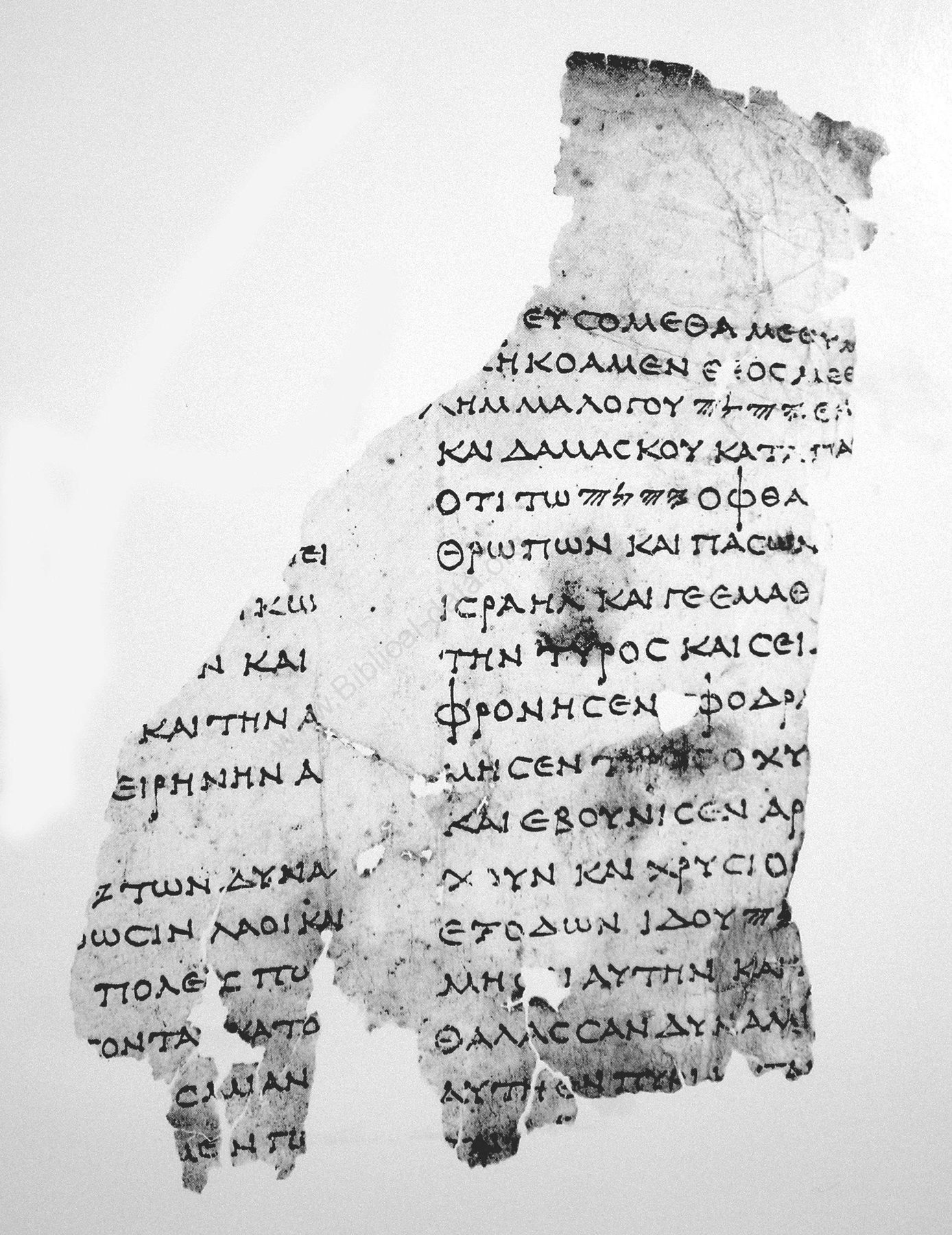
What emerged was legible Hebrew text across several columns, identified as material from the beginning of Leviticus. The letters that survived, once digitally flattened and stitched, matched the Masoretic consonantal text - the standard Hebrew Bible text still used today - closely enough that scholars described it as effectively identical, aside from the ordinary small variations found across any hand-copied manuscript tradition. That degree of agreement, across roughly a millennium and a half between this scroll and the medieval manuscripts the Masoretic tradition otherwise rests on, is itself part of the evidence: the text of Leviticus had already reached something very close to its later fixed form well before the copy that burned at En-Gedi was written.
Why it matters
Before the En-Gedi scroll was read, the manuscript record for the biblical text jumped in a single step from the Dead Sea Scrolls, mostly a few centuries earlier, to the medieval codices that anchor the Masoretic tradition. The gap between them was real, and it left room for debate about how much the text might have shifted in the intervening centuries of hand copying. En-Gedi sits inside that gap. It is a dated, physical, findable Torah text from Roman-period Judea that reads, letter for letter in its surviving portions, like the text still printed and read in synagogues now. It does not prove nothing ever changed anywhere in the tradition - no single scroll could - but it is direct evidence that this specific community, using this specific scroll, was already working from essentially the text we have.
There is also a plainer point, less about textual history than about method. The scroll demonstrates that a document judged permanently unreadable, and treated as such for decades, was not in fact lost. It was waiting for a technique that did not yet exist. Other charred scrolls and fragments, from En-Gedi and elsewhere, remain in storage in the same condition the En-Gedi scroll was in until it was scanned - which is a reasonable basis for expecting more readings, not fewer, from material already sitting in museum stores.
The recovered text
The legible portions of the En-Gedi scroll correspond to the opening chapters of Leviticus, dealing with the burnt offering and the grain offering. The consonantal text matches the Masoretic tradition closely, making it, at the time of its identification, the earliest known copy of a Pentateuchal book found still inside a synagogue Torah ark, and among the oldest Torah texts known from any context after the Dead Sea Scrolls. The digital unwrapping was carried out using micro-CT scanning combined with software developed for reconstructing text from damaged and rolled manuscripts, work associated with a research effort led by the computer scientist Brent Seales at the University of Kentucky, published in the journal Science Advances.
Text: Israel Antiquities Authority; digital reconstruction: University of KentuckyStory & Stone · Object
See it all in action: The Words That Outlasted Everything →