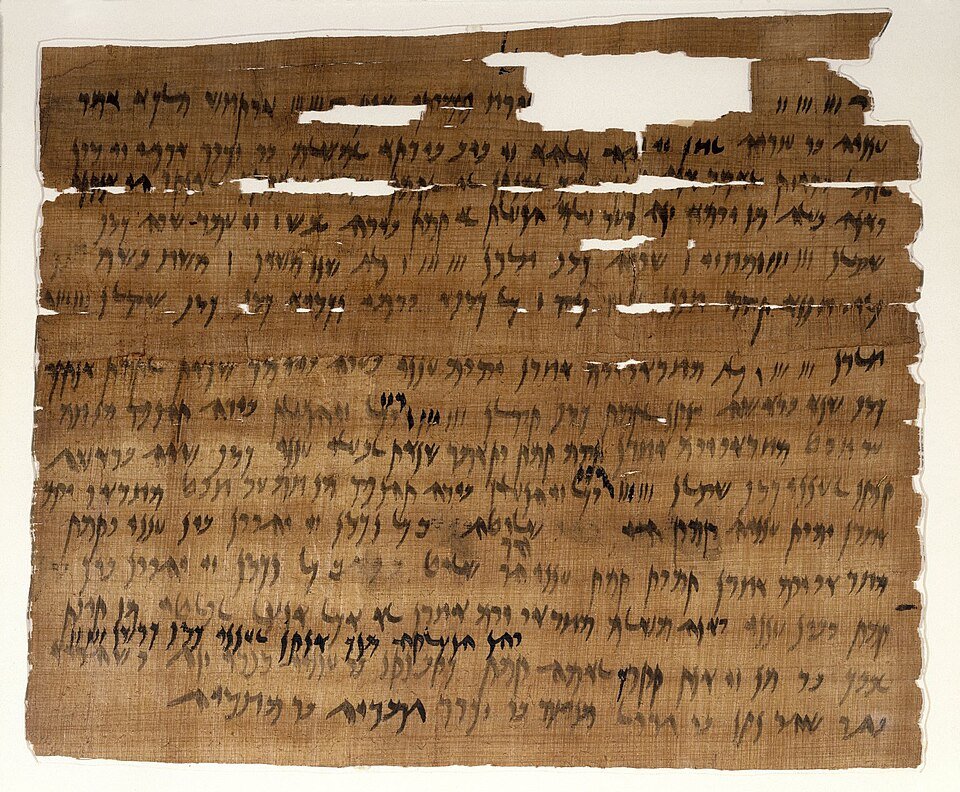
In the closing years of the fifth century BCE, a piece of papyrus was folded, addressed and sent up the Nile to Elephantine, an island garrison town near modern Aswan, at the southern edge of the Persian empire's Egyptian province. It was a letter of instruction, not scripture, not liturgy - the ancient equivalent of a memo. It told a community of Jewish soldiers stationed there how to observe an upcoming festival: which dates, which restrictions, what to avoid and for how long. That the letter survived at all, buried in the dry sand of an island that has kept its rubbish for twenty-five centuries, is its own kind of miracle. That it survived saying what it says is the reason it matters.

What was found, and where
Elephantine has produced one of the largest caches of Aramaic documentary papyri from antiquity: letters, contracts, marriage documents, court records and administrative correspondence belonging to the Jewish garrison community, recovered from the settlement's ruins across a series of excavations and purchases in the late nineteenth and early twentieth centuries. Because Elephantine lies in Upper Egypt's dry climate, organic material that would have rotted almost anywhere else survived intact for millennia. The papyri were dispersed to several collections as they came onto the market and into museum hands, which is why Elephantine material today sits in Berlin, Oxford, New York and elsewhere rather than in one place. The letter now known as the Passover Papyrus is part of the Elephantine holdings of the Egyptian Museum, Berlin.
Unlike a stele or a temple wall, this is not a monument built to be read by strangers. It is a private administrative letter that was never meant to outlive its season - and it did, purely because it ended up in a rubbish heap that nobody disturbed for twenty-five hundred years.
The Passover Letter
An Aramaic papyrus letter addressed to the leadership of the Jewish garrison at Elephantine, dated within the reign of the Persian king Darius II - the year corresponds to 419 BCE. The surviving text is damaged and incomplete, but enough remains to show the sender instructing the garrison on the observance of the Feast of Unleavened Bread: a run of days on which leaven was to be avoided, with the requirement that beer and other leavened items be put away or sealed for the duration. The letter is written in the terse, practical register of official correspondence, not narrative or law code. It was found among the mass of Aramaic documentary papyri recovered from the Elephantine site and is held today among the Elephantine papyri of the Egyptian Museum, Berlin.
Egyptian Museum, BerlinWhat the letter actually says
The text is fragmentary - papyrus tears, and this sheet has lost portions of its opening and some of its lines - but its surviving content is procedural rather than theological. It gives dates. It specifies a period during which no leaven is to be eaten or kept in the house, and it instructs that beer, understood as a leavened product in this context, be sealed away for the festival's duration. It is addressed to named figures at the head of the garrison community and appears to have been sent with some degree of official backing, which has led to its being read as an instruction travelling down through, or alongside, Persian administrative channels rather than as a private religious circular.
What it does not do is quote scripture, cite the Exodus story, or explain why the festival matters. It assumes the reader already knows that. It is closer to a compliance notice than a sermon - which is precisely what makes it valuable. It shows a festival being administered, on a fixed calendar, with specific behavioural requirements, to a Jewish community living far from Jerusalem, a century before any surviving rabbinic text lays out Passover practice in comparable procedural detail.
The scholarly debate
Because the letter is damaged, its precise scope is argued over. Some readings treat it as instructions covering both Passover proper and the separate but adjoining Feast of Unleavened Bread, run together into a single set of directions - which would mirror the way the two festivals are treated jointly elsewhere in the biblical calendar. Others are more cautious about how much of the "Passover" language can be reconstructed from the surviving fragments, since the word itself does not survive intact in every line where it has sometimes been restored. There is also debate about how much authority stands behind the letter - whether it represents a directive with real administrative weight, reaching the garrison through or alongside Persian channels, or a religious instruction from a Judean authority that simply travelled through the same postal networks the empire made available. The fragmentary state of the papyrus means these questions are unlikely ever to be settled beyond argument, but the core fact holds under any reading: a festival calendar was being administered to Jews outside the land of Israel, in writing, in the late fifth century BCE.
It quotes no scripture and explains nothing. It assumes the reader already knows why the festival matters, and simply tells them the dates. Judaism, run by post.
The Elephantine archive
The Passover Letter is one document within a much larger body of Aramaic papyri recovered from Elephantine, documenting the daily and civic life of the island's Jewish garrison community: property transfers, marriage contracts, loan agreements, court petitions and correspondence with officials in Egypt and Judea. The archive as a whole is dispersed across several institutional collections, reflecting how the papyri were acquired piecemeal in the decades after their discovery. It remains one of the fullest surviving records of everyday Jewish communal life anywhere in the ancient world, and it predates almost all surviving rabbinic literature by several centuries.
Elephantine papyri, multiple collections including Egyptian Museum, BerlinWhat makes the Passover Papyrus worth pausing on is not drama - there is no dramatic find story here, no thirteen-year-old with a hammer, just the patient recovery of administrative rubbish from a dry island. Its value is quieter than that. It shows the festival already functioning as an institution, with a fixed calendar and enforced practice, reaching a garrison community a very long way from Jerusalem. The instructions did not need to explain themselves because the community already knew what they were being told to do. That is not the origin of a tradition. That is a tradition already old enough to be administered by letter.
Further reading