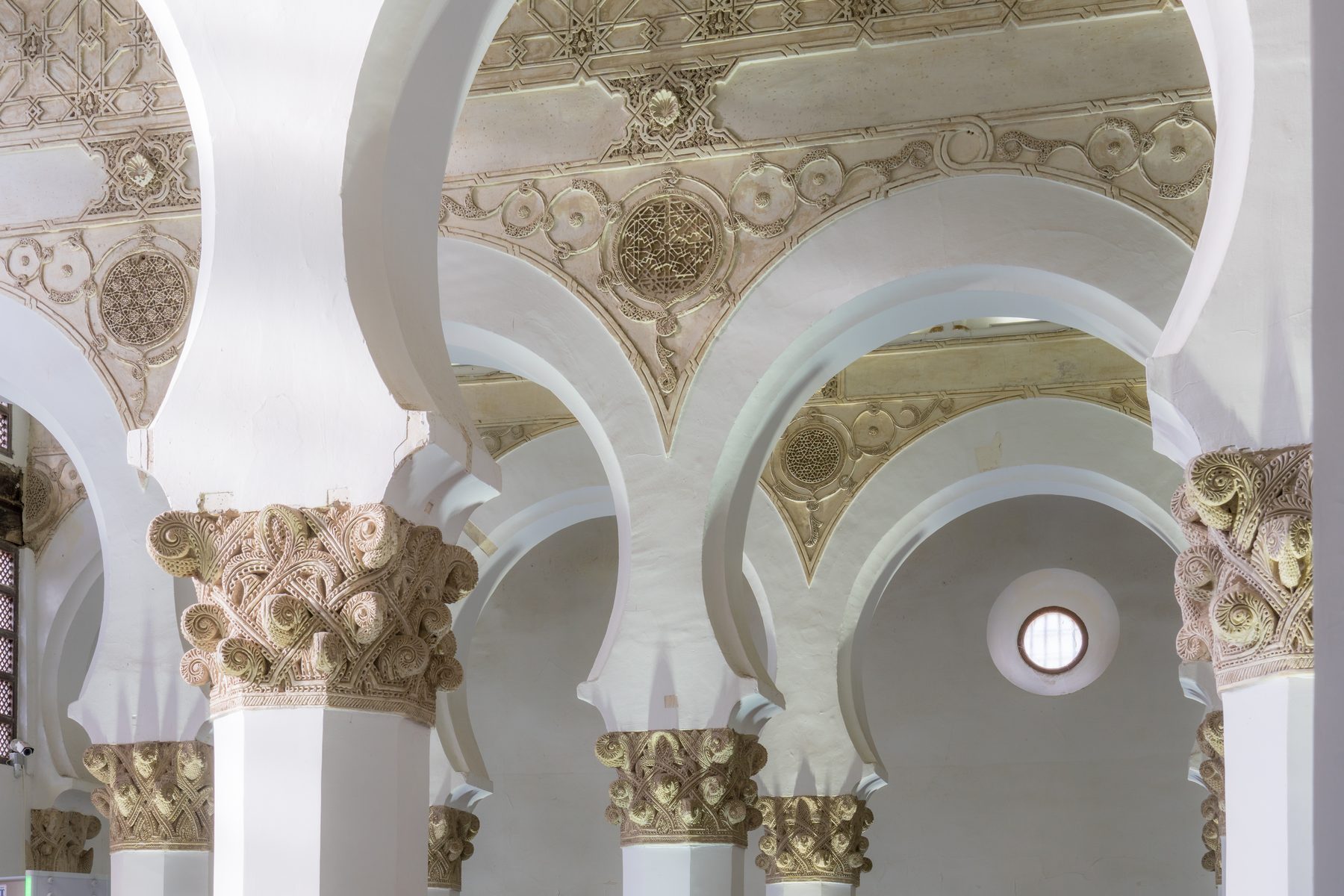
Walk into the prayer hall of El Transito in Toledo and the first thing that registers is not any single inscription but the sheer density of the walls: band after band of carved stucco, Hebrew lettering running in continuous friezes below a lattice of Mudejar plasterwork, the whole surface worked as finely as a manuscript page. It was built as a private synagogue for one man's household and community, and it survives largely intact - a rare thing anywhere, rarer still for a medieval Jewish building in Spain. What makes it more than a beautiful room is what the walls themselves say, and who paid for them to say it.
The synagogue was built in Toledo in the mid-fourteenth century for Samuel ha-Levi Abulafia, treasurer to King Pedro I of Castile. Toledo was then a Castilian royal city with a substantial and long-established Jewish community, and ha-Levi was among its most powerful members - a financier and administrator close enough to the crown to build, on his own initiative, one of the most lavishly decorated synagogues to survive from medieval Europe. The building he raised is not a place that reads as embattled or improvised. It reads as a statement of arrival.

What the walls say
The decoration runs in continuous bands of Hebrew text worked into the plaster around the upper walls of the hall, drawing on the Psalms and other biblical and liturgical language, and including dedicatory inscriptions naming Samuel ha-Levi and praising both him and King Pedro I as patron and protector of the building. Interwoven with the Hebrew bands, at points around the hall, are the heraldic arms of the Crown of Castile and León - the castle and the lion - carved in the same plasterwork alongside the Islamic-derived geometric and vegetal ornament typical of Mudejar craftsmanship in fourteenth-century Toledo. Three visual languages sit on one wall: scripture in Hebrew letters, the blazon of a Christian crown, and a decorative idiom shared across Toledo's mosques, churches and synagogues alike. Nothing about the combination reads as a compromise. It reads as a courtier confident enough in his position to have his king's arms carved into the walls of his own house of prayer.
That confidence is the evidence the building offers, and it is a different kind of evidence from a chronicle or a royal charter. A text can claim a Jewish official's standing at court. A wall built at his own expense, carrying his name beside the king's, and left to stand ever since, shows what that standing looked like when it was spent on stone and plaster rather than on words.
The El Transito Synagogue
A synagogue built in Toledo for Samuel ha-Levi Abulafia, treasurer to King Pedro I of Castile, in the Mudejar architectural style current in the city. The prayer hall survives substantially intact, its upper walls carved with continuous bands of Hebrew inscription - biblical and dedicatory text - interspersed with the heraldic arms of Castile and León. It stands on its original site in Toledo's former Jewish quarter.
Sephardic Museum, ToledoThe fall that followed
The building's confidence is easier to read once the rest of Samuel ha-Levi's story is known. He rose to be one of the most powerful men in Pedro I's Castile, entrusted with the kingdom's finances and evidently rich enough to fund a synagogue on this scale from his own resources. He also fell from that height with a suddenness that royal favour in this period regularly produced: he lost the king's confidence, was arrested, and died in royal custody, his wealth confiscated by the crown he had served. The synagogue therefore preserves, in a way few other buildings do, both halves of a single career - the peak, carved plainly into the walls, and the fall that came after it, which the walls say nothing about at all because they were finished before it happened.
After the expulsion of the Jews from Spain in 1492, the building was handed to a Christian military order and converted into a church, a common fate for synagogues across Iberia in this period. That conversion is, in its own way, part of the evidence: it is why the structure survived at all rather than being demolished, and it is why later restoration work, aimed at recovering the medieval fabric, had a building to recover. The synagogue now houses Toledo's Sephardic Museum, and the inscriptions that once addressed a fourteenth-century congregation are read today as a primary source for the language, the patronage and the self-presentation of a Castilian Jewish elite at the height of its integration into royal government.
The inscription programme
The Hebrew inscriptions carved into the upper walls combine passages drawn from the Psalms and other liturgical language with dedicatory text naming Samuel ha-Levi and King Pedro I. They run as continuous bands around the hall, executed in the same Mudejar plasterwork technique as the surrounding geometric and vegetal ornament and the Castilian royal arms set among it. The inscriptions are treated by historians of the building as a primary, contemporary source for how its patron presented his own status and his relationship to the crown.
In situ, El Transito Synagogue, ToledoWhat the El Transito Synagogue proves is narrow but solid: that a Jewish official could rise high enough in fourteenth-century Castile to commission a building of this ambition in the king's own name, and that he did so without apparent anxiety about placing Hebrew scripture and royal heraldry on the same wall. It does not prove that the position was safe - the rest of Samuel ha-Levi's life argues the opposite - but it proves, in plaster that has now outlasted him by nearly seven centuries, exactly how that confidence looked while it lasted.
Further reading