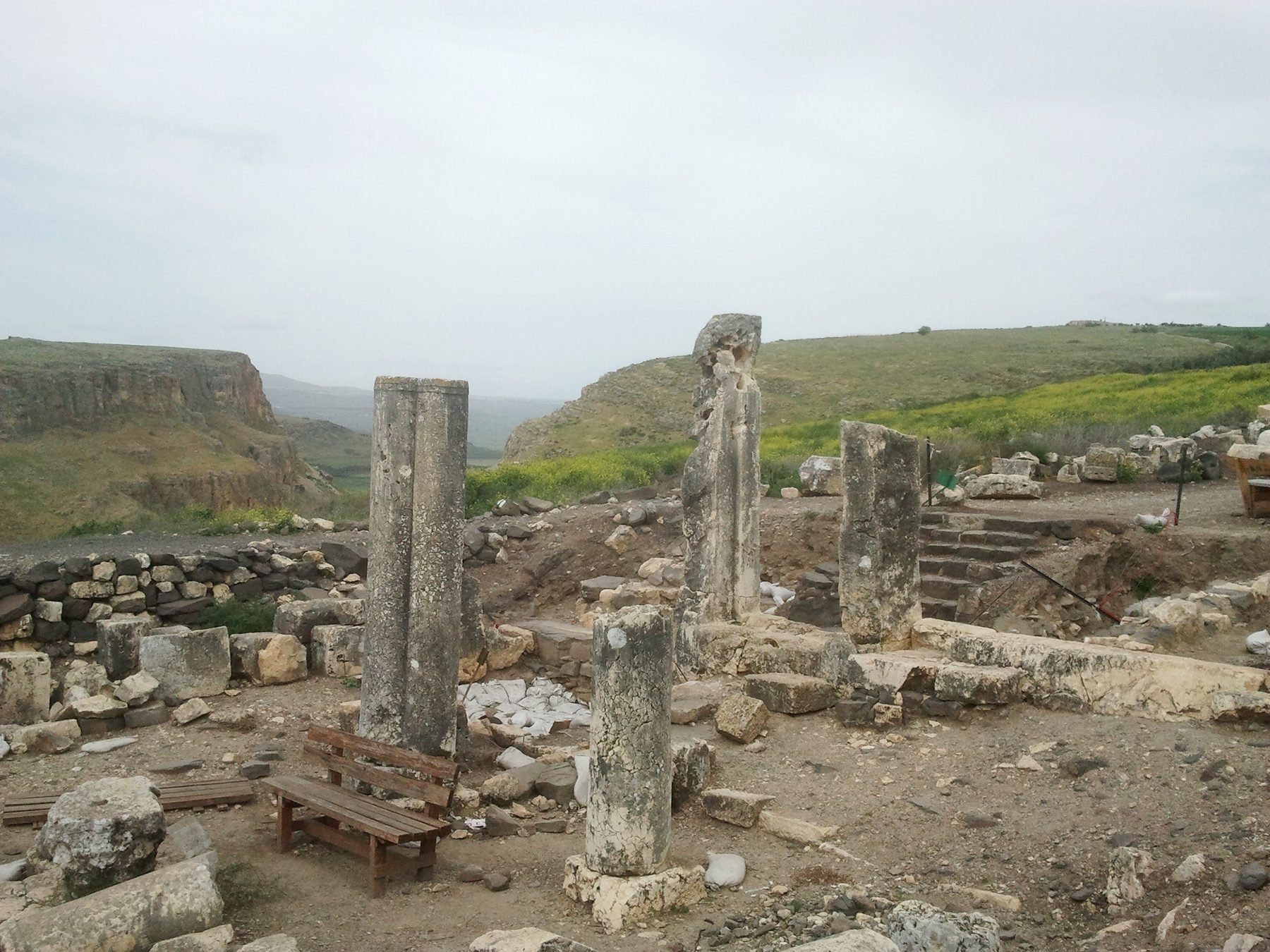
Ein Nashut sits on a basalt plateau in the Golan, a scatter of black volcanic stone that was once a village and, at its centre, a synagogue. Nobody built this place to be found two thousand years later. It was built to be used - prayed in, sat in, walked past on an ordinary Tuesday - which is exactly what makes it useful now. It is not a text arguing that Jews lived in the Golan in late antiquity. It is the house they built while they were doing it.
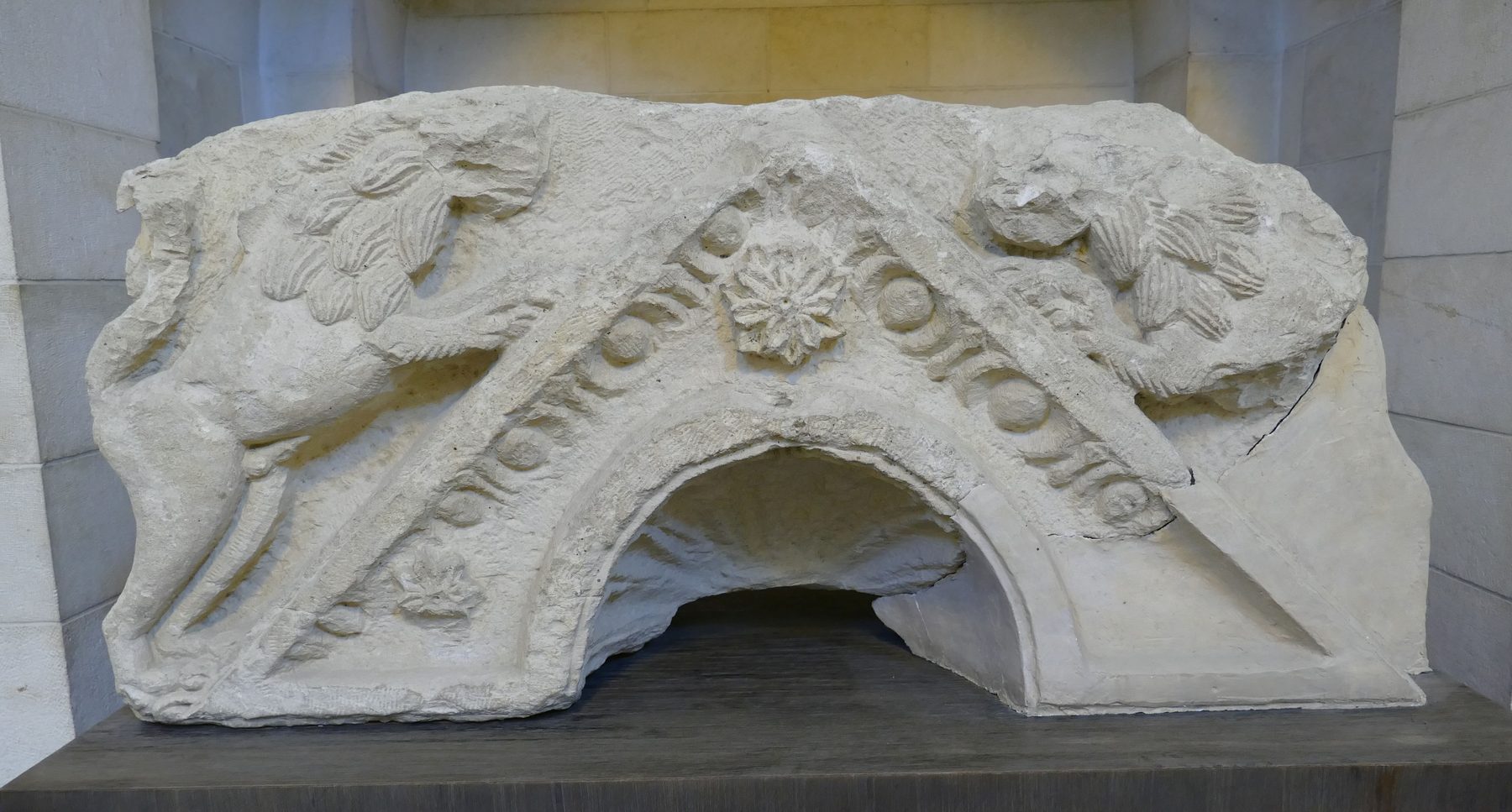
The building is basalt because basalt is what the Golan gives you. The local stone is a hard, dark volcanic rock, and every synagogue in the region - Ein Nashut among them - is cut from it, which is part of why these buildings read so differently from the pale limestone synagogues of the Galilee proper. The material is blunt and heavy, and the carving on it is correspondingly bold: deep-cut relief rather than fine incision, animals and rosettes standing out from the lintels in thick, confident lines.

What the carving shows
The decoration is architectural rather than narrative: it belongs to lintels, door frames and a niche that would have housed the Torah shrine, not to a mosaic floor telling a story panel by panel. Among the motifs are a pair of confronted lions, an eagle with outstretched wings, wreaths, rosettes and vine ornament - the standard repertoire of the Golan synagogue group, of which Ein Nashut is one of the best preserved examples. On one carved block a small human figure appears in a dancing pose, arms raised, worked in the same deep relief as the animals around it.
None of this is unusual for the region on its own. Eagles and lions turn up across ancient synagogue decoration from the Galilee to the Golan, drawing on a shared late-antique visual vocabulary that Jewish communities used freely alongside their pagan and Christian neighbours. The Torah shrine niche, and the plan of the building itself - a rectangular hall, benches along the walls, an entrance oriented so that worshippers faced towards Jerusalem - are what make the identification as a synagogue secure, not any single carved image.
A basalt hall on the Golan plateau
The synagogue was excavated as part of a wider survey of ancient sites on the Golan Heights and belongs to a recognised group of basalt-built synagogues in the region, alongside sites such as Qasrin and Deir Aziz. The building's plan, its Jerusalem-facing orientation, and its Torah shrine niche identify it as a synagogue rather than a domestic or civic structure. Its carved stonework remains among the finest of the Golan group.
Golan Heights, IsraelWhy a village synagogue matters
Ein Nashut is not a grand civic monument and was never meant to impress an empire. That is its evidential value. A capital city can be held for a generation by a garrison and a flag; a village that built itself a basalt synagogue, cut a Torah niche into the wall, and oriented its hall towards Jerusalem was making a much quieter and much harder claim - that this was simply where Jewish life happened, on an ordinary plateau, for however many generations it took to wear those stone benches smooth. The Golan synagogue group, Ein Nashut among the best preserved of them, is the physical record of scores of such communities across a region that later history sometimes treats as though it were empty of them.
The carving matters for a second, more particular reason. Lions, eagles and a dancing figure are not devotional images in the way a mosaic Torah shrine or a menorah is; they are decoration, the kind of thing a community chooses because it is handsome, familiar and available, not because it is doctrine. That a Jewish congregation in the Golan felt free to carve them onto the doorway of its own house of prayer says something about the confidence and the everyday texture of that community - comfortable enough in its surroundings to borrow freely from them, and secure enough in what the building was for that borrowed ornament never put its identity as a synagogue in any doubt.
Part of a regional pattern, not an isolated find
Ein Nashut is one of a cluster of basalt synagogues identified across the Golan plateau, sharing construction material, architectural plan and much of their decorative vocabulary. Taken together, the group corroborates a settled, organised Jewish presence across the Golan in late antiquity, rather than a single exceptional site.
Golan Heights survey sites