Most of what survives from the Jewish past arrives in fragments - a seal, a sherd, a scrap of parchment behind glass. The Dohany Street Synagogue is the opposite kind of evidence. It is enormous, intact and still in daily use, and its size alone makes an argument: by the middle of the nineteenth century, the Jewish community of Budapest was confident enough, prosperous enough and rooted enough in its city to build a house of worship on a scale that competed with the grandest cathedrals of Europe, on one of the city's own boulevards, in full public view.
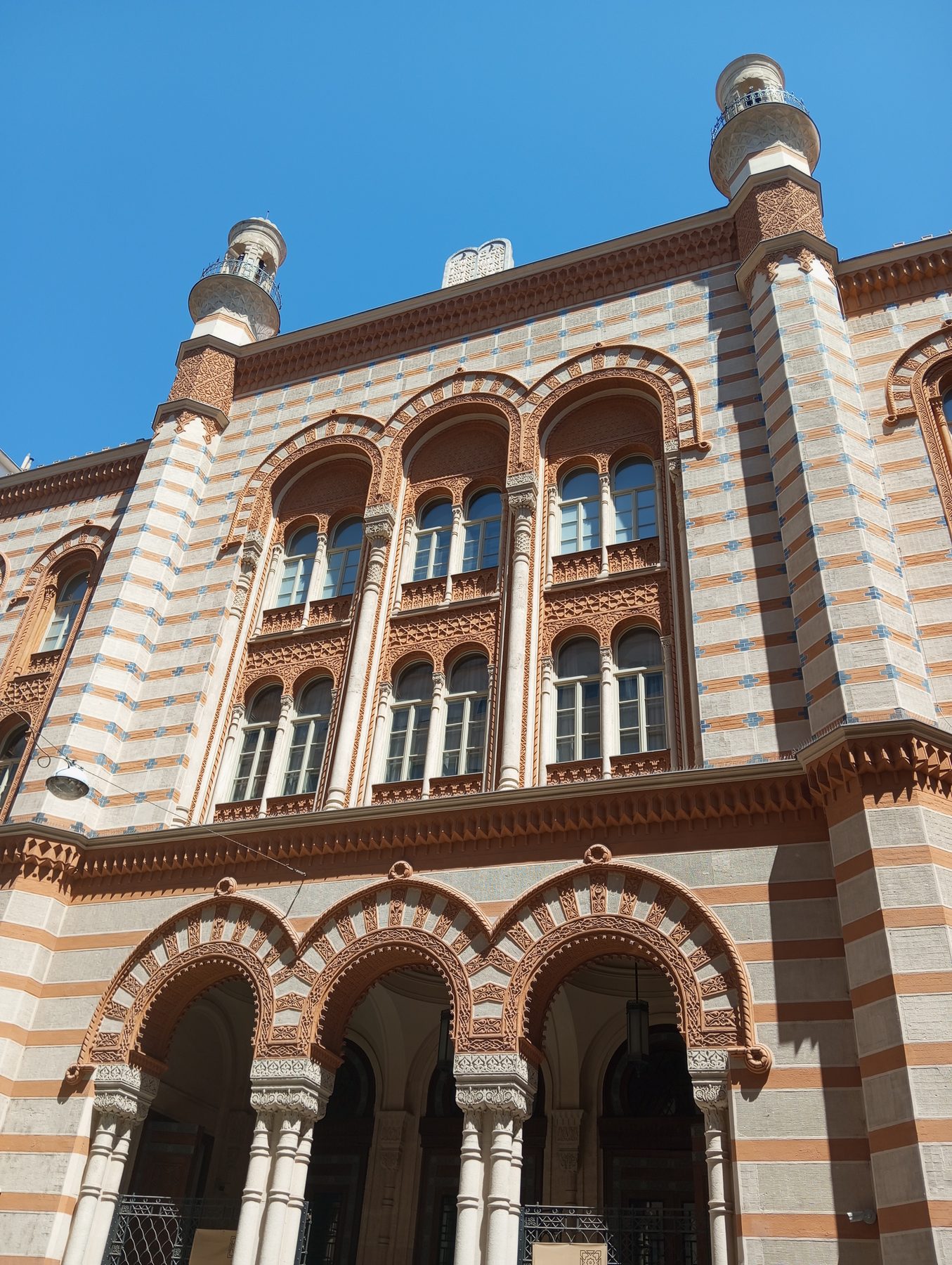
The building stands on Dohany utca in the historic Jewish quarter of Pest, a short walk from the Danube. Twin onion-domed towers rise on either side of a Moorish Revival facade of striped brick and stone, a style chosen deliberately to signal an Oriental heritage distinct from the Gothic and Romanesque churches around it. Inside, the nave seats a congregation numbering in the thousands beneath a vaulted ceiling and an organ loft - a synagogue built, unapologetically, at cathedral scale.

What the building records
Construction began in the 1850s and the synagogue was consecrated in 1859, commissioned by Pest's Neolog Jewish community - a reform-minded stream of Hungarian Judaism that had broken from Orthodox practice on questions of liturgy and synagogue design, including the introduction of an organ. The architect was a non-Jewish Viennese designer working in the fashionable Moorish Revival idiom, a choice that placed the building in company with other grand nineteenth-century European synagogues that reached for a shared Islamic Iberian past rather than the architecture of the churches next door. The result announced, in brick and stone on a major city street, that Judaism in Hungary intended to be seen.
The synagogue complex was not built as a single hall. Attached to it are a museum documenting the history of Hungarian Jewry and a cemetery in the courtyard - itself a departure from Jewish burial custom, created out of necessity during the Second World War, when the synagogue stood inside the boundary of the Budapest ghetto and thousands who died there had nowhere else to be buried. The building therefore carries, physically, both the community's confident beginning and one of its darkest chapters, on the same footprint.
The Great Synagogue is built and consecrated
Built for Pest's Neolog Jewish community in the Moorish Revival style, with twin towers and a nave large enough to seat several thousand worshippers, the synagogue was consecrated in 1859. Its scale and its prominent street-facing position in central Pest are themselves evidence of a community with the wealth, confidence and civic standing to build at the size of the great churches around it, in a period of expanding Jewish emancipation in the Habsburg lands.
In situ, Dohany utca, BudapestThe ghetto years and the courtyard graves
In late 1944, the German occupation and the Hungarian fascist authorities enclosed the historic Jewish quarter of Budapest, including the synagogue, inside the walls of a ghetto. Conditions of overcrowding, starvation and cold through the winter of 1944 to 1945 killed thousands of people confined there before the Soviet army reached the city in January 1945. Normal burial was impossible under siege conditions, and the dead were interred in the synagogue's own courtyard and grounds - the mass graves that remain there today, marked and maintained, rather than concealed or removed.
Those graves are themselves a kind of evidence, distinct from any document: physical proof, on the ground, of what happened inside the ghetto walls in those months. The synagogue that had been built as a statement of arrival became, eight decades later, the site of the community's worst loss - and it was not rebuilt elsewhere or quietly forgotten. It stands today with both chapters visible, the sanctuary and the graves a few steps apart.
Mass graves in the synagogue courtyard
During the Budapest ghetto's confinement over the winter of 1944 to 1945, thousands of Jews who died of starvation, cold and violence were buried in the grounds of the Dohany Street Synagogue, inside the ghetto boundary, because burial elsewhere was not possible under siege conditions. The graves remain in the synagogue courtyard, marked and maintained as part of the site, alongside a memorial to the victims of the Holocaust in Hungary in the adjoining garden.
In situ, synagogue courtyard, BudapestWhy it matters as evidence
A synagogue this size, standing on its original site since the 1850s and still in active religious use, does something a museum artefact cannot: it lets a visitor stand inside the same volume of space a nineteenth-century Budapest congregation stood in, and then walk a few metres to graves from 1944 without leaving the property. It corroborates, physically, two separate and true things about Hungarian Jewish history - a community confident and prosperous enough to build at monumental scale in the heart of its capital, and a community that suffered catastrophic loss on that same ground within living memory of the building's own construction. Neither fact erases the other, and the building holds both without needing a caption to explain them.
The synagogue's continued use for worship, alongside its museum and memorial functions, also makes it unusual among major European synagogues of its era: it was not converted to another purpose, left as a ruin, or preserved only as a monument. It remains what it was built to be, which is itself a form of evidence about continuity.
The largest synagogue in Europe was not built to be modest. It was built to be seen, and it still is.
The Heroes' Temple and the Jewish Museum
A smaller adjoining sanctuary, the Heroes' Temple, was added in the twentieth century to commemorate Hungarian Jews who died serving in the First World War, and the Hungarian Jewish Museum was built beside the main synagogue on the site of the house where Theodor Herzl was born. Together the complex documents, on one plot of land, the community's religious life, its military service to Hungary, its intellectual legacy and its history as a persecuted minority - a physical archive as much as a place of worship.
In situ, Dohany utca complex, BudapestFurther reading