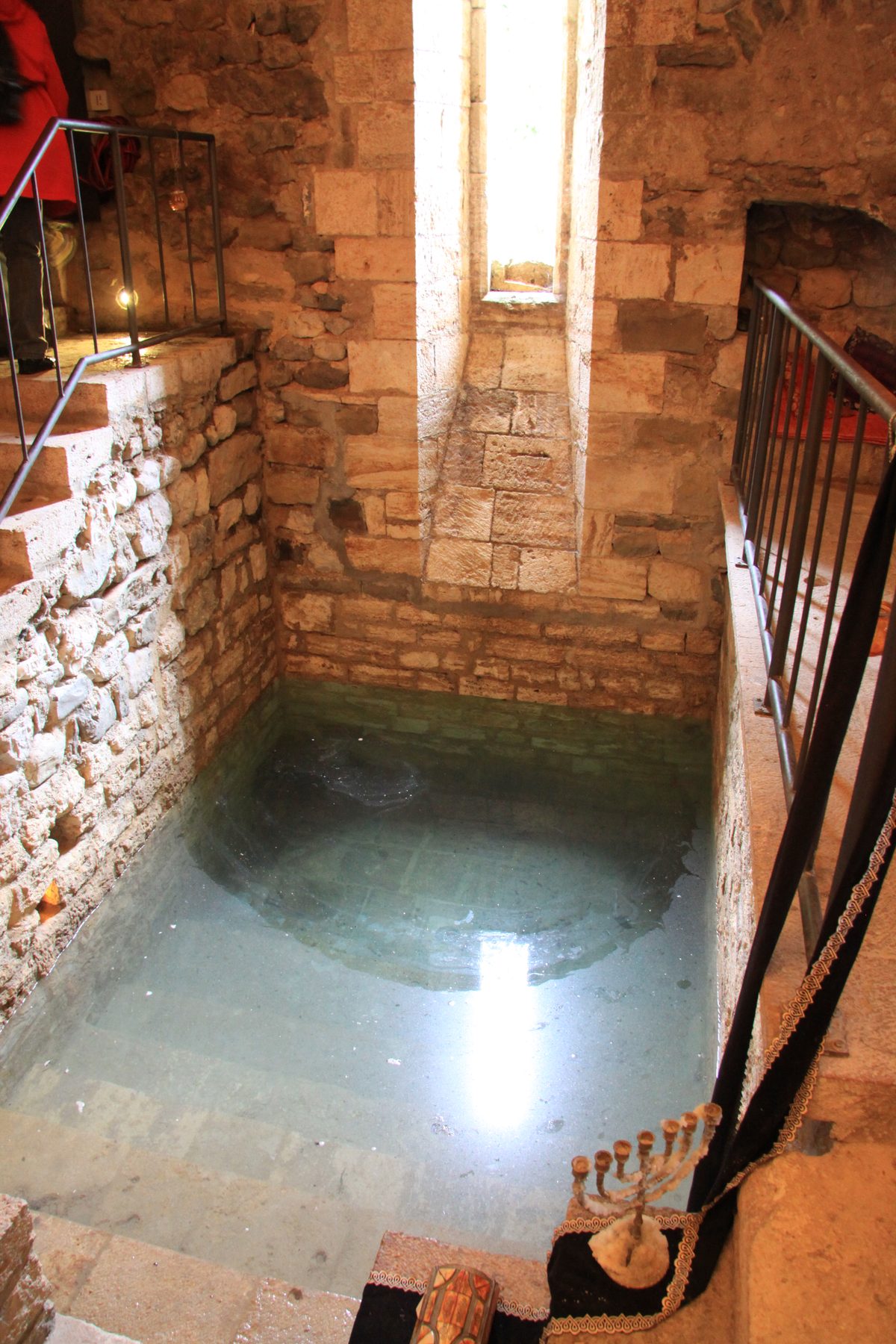
A mikveh does not need to say what it is. The shape tells you: a narrow stone shaft, cut straight down through the earth until it meets natural groundwater, with a staircase hugging the wall so a person can walk down to the water rather than be lowered to it. Cologne has one of these, sunk into the ground at the heart of what was for centuries the city's Jewish quarter, on the same plot of land where the town hall now stands. The buildings above it were destroyed and rebuilt more than once. The shaft, being underground, kept surviving the fires that took everything above it.

A shaft built to reach water, not to hold it
The building itself is simple in principle and demanding in execution. Jewish law requires a mikveh's water to be living water - groundwater or rainwater that has not been drawn and carried in vessels - so the only way to build one in a city without a spring at hand is to dig down until you meet the water table and build a staircase around the resulting shaft. That is what stands under Cologne's Rathausplatz: a deep, stone-lined descent, its walls carrying the round-arched masonry typical of the Romanesque building style, leading down to a small chamber at the water itself. It is usually dated to around the middle to second half of the twelfth century, making it one of the oldest structures of its kind to survive north of the Alps, though the exact date of construction is argued from the masonry and stratigraphy rather than fixed by any inscription on the stone.
The mikveh did not stand alone. It was one building among several - a synagogue, a community hall, houses - that together made up the medieval Jewish quarter clustered around what is now the town-hall square, in continuous or near-continuous Jewish use for roughly a thousand years before the community was expelled from the city in the fifteenth century. The quarter was attacked more than once in that span, including during the violence that accompanied the First Crusade at the end of the eleventh century and again during the persecutions that swept German cities at the time of the Black Death in the mid-fourteenth century. Buildings were burned and rebuilt. The shaft in the ground kept its shape through all of it, because there was very little about a hole cut into rock that fire or a mob could actually undo.
The Cologne Mikveh
A stone-lined ritual bath cut down to groundwater level beneath Cologne's medieval Jewish quarter, reached by a stepped staircase built into the shaft wall and carrying Romanesque round-arched masonry. Commonly dated to around the twelfth century on the basis of its construction technique, it is among the oldest surviving mikva'ot in the region north of the Alps. The structure survived the destruction of the buildings above it across several episodes of violence against the community and remains in situ, conserved beneath the city's Rathausplatz.
MiQua - LVR-Jewish Museum in the Archaeological Quarter CologneThe oldest address on the map
What makes the site more than a well-preserved bathhouse is what it corroborates about how early, and how continuously, Jews lived in this particular city. Cologne holds the earliest surviving documentary reference to a Jewish community anywhere north of the Alps: an edict issued in the name of the emperor Constantine in the early fourth century CE, addressing Jews of Cologne in the context of municipal office-holding. That is a written record from Roman antiquity, centuries before the mikveh was cut. The excavated quarter does not prove a straight line of unbroken residence from that fourth-century reference to the twelfth-century building - the sources for the intervening centuries are thin - but it does something the document alone cannot: it shows a fully built, functioning Jewish community with its own consecrated infrastructure occupying the same ground in the high medieval period, with the physical apparatus of religious life still standing where it was built.
The location itself argues something too. The quarter sat at the literal centre of the medieval city, adjoining the marketplace and, eventually, the town hall - not tucked away at the margins. A community does not end up at the civic heart of a major Rhineland trading city by accident or on sufferance alone; it takes root there, does business there, and is still building durable stone infrastructure there centuries in. The mikveh is the clearest physical trace of that rootedness, because unlike a market stall or a house, a ritual bath is not built for convenience. It is built for people who intend the community, and its observance, to last.
The medieval Jewish quarter of Cologne
Centred on ground now occupied by Cologne's Rathausplatz, the quarter held a synagogue, community buildings and housing alongside the mikveh, and was repeatedly damaged in periods of violence against the community, including around the First Crusade and during the mid-fourteenth-century persecutions associated with the Black Death. The city formally expelled its Jewish community in 1424. The site was substantially rediscovered by archaeological excavation in the twentieth century and is now conserved and interpreted at MiQua, on the same footprint the community occupied.
MiQua, Rathausplatz, CologneFurther reading
Story & Stone · Glass Case
Read another object: The LMLK Royal Seal Impressions →