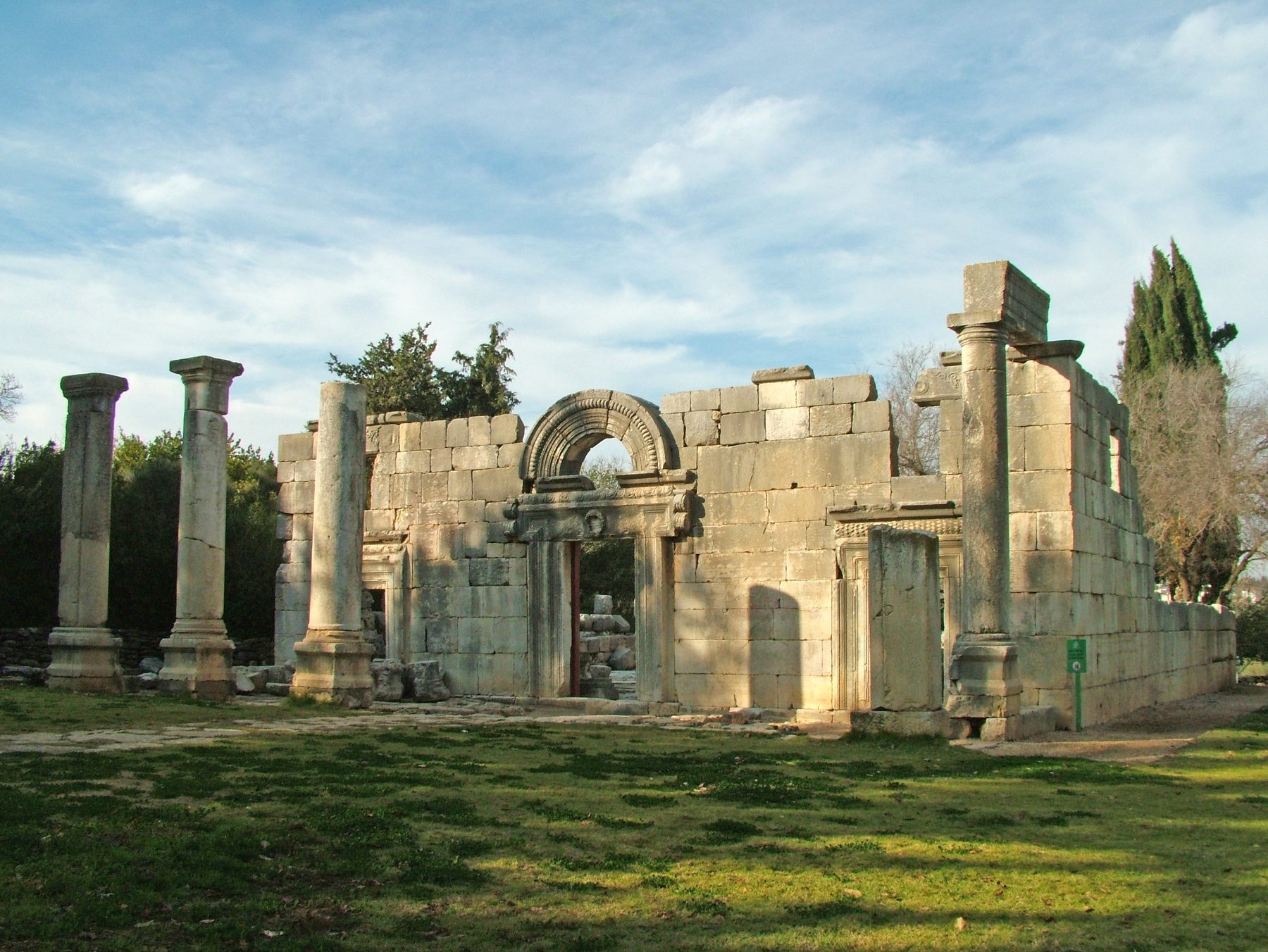
Chorazin sits on a basalt shelf above the Sea of Galilee, a few kilometres north of Capernaum, built almost entirely from the black volcanic rock that litters the surrounding fields. The ruin is dominated by its synagogue: a substantial public building of dressed basalt blocks, with rows of columns, a decorated façade, and stone benches lining the interior walls where a congregation would have sat. Set into the floor near the building's focal point is a carved stone chair, a single block cut into a seat with armrests and a low back - what later Jewish tradition calls the Seat of Moses, the place from which a reader or teacher addressed the assembly. It is one of only a small number of such chairs to survive from ancient synagogues, and it is still in situ, in the ruin at Korazim, rather than in a museum case.

A town of black stone
Chorazin - Korazim in modern Hebrew - was a Jewish town of the Roman and early Byzantine periods, built on and from the basalt outcrop it sits on. Basalt is a hard, dark volcanic stone, common across the eastern Galilee, and it gives the whole site its distinctive look: black walls, black column drums, black lintels, quite unlike the pale limestone used further south in Judaea. The synagogue itself, excavated across the twentieth century, is a large rectangular hall with two rows of columns dividing the interior into a nave and side aisles, stone benches around the walls for the congregation, and an ornately carved façade facing south, toward Jerusalem. Fragments of decorative carving recovered from the building include vine scrolls, geometric borders and animal figures worked into the basalt with real skill - proof that a fairly small Galilee town could commission accomplished stonework for its house of worship.
The building's date has been debated since excavation began. Early excavators favoured a second or third century CE date; later work, drawing on coins and pottery from the site's occupation layers, has tended to place the standing synagogue somewhat later, within the broader Roman-to-Byzantine centuries when monumental Galilee synagogues of this general "Galilean type" - basalt or limestone halls with columned interiors and carved façades - were being built at Chorazin, Capernaum and elsewhere around the lake. The town itself was occupied across a longer span, with earlier and later phases either side of the synagogue's main use.
The Chorazin synagogue
A monumental public building of dressed black basalt, with a colonnaded hall, stone benches along the walls, and a carved façade facing toward Jerusalem, built in the Jewish town of Chorazin in the eastern Galilee during the Roman period. Excavated across the twentieth century, it is one of a group of large Galilean synagogues built around the Sea of Galilee in antiquity, and it remains standing, in part, on its original site.
In situ, Korazim National Park, GalileeThe Seat of Moses
Set into the synagogue floor is a single block of basalt carved into a chair, with a curved back and armrests, worked to look almost like a piece of furniture rather than raw stone. It carries a short dedicatory inscription in Aramaic recording that it was given in memory of a member of the community. Rabbinic literature refers to a "seat of Moses" as the honoured place from which the Torah reading or teaching was conducted in a synagogue, and the same phrase appears in the New Testament, where it is said that the scribes and Pharisees "sit on Moses' seat." Whether every reference to that seat describes a literal chair like the one at Chorazin, or uses the phrase more as a figure of speech for a position of authority, is not settled - but the Chorazin chair is physical proof that at least one Galilee synagogue had an actual stone seat answering to that description, built into the room where the congregation gathered.
Comparable carved seats have turned up at a small number of other ancient synagogue sites, which places Chorazin's chair within a real, if limited, category of furniture rather than treating it as a curiosity. Its survival in situ, in the excavated hall rather than removed to storage, lets a visitor stand in something close to the spatial relationship a Roman-period congregation at Chorazin would have had with it: benches around the walls, columns dividing the space, and near the front, kept clear for use, a chair of black stone.
The carved basalt seat
A chair cut from a single block of basalt, with a shaped back and armrests, set into the floor of the Chorazin synagogue and carrying a short Aramaic dedicatory inscription. It corresponds to the "seat of Moses" described in rabbinic sources and in the Gospel of Matthew as the place of teaching authority in a synagogue, and is among the few such carved seats known from ancient synagogue excavation.
In situ, Korazim National Park, GalileeThe town that was cursed
Chorazin appears in the Gospels of Matthew and Luke among three towns on the Sea of Galilee - with Bethsaida and Capernaum - condemned for failing to respond to the deeds done in them, in language harsher than that used against pagan cities such as Tyre and Sidon. The Gospels do not describe what happened in Chorazin itself; the town is named only in that list of judgement. The archaeology cannot confirm or deny the substance of that text - excavation finds a working Jewish town with a substantial public synagogue, not a record of any preaching that took place there - but the site does confirm that Chorazin was a real, identifiable place, inhabited by a Jewish community with the means and the will to build a fine synagogue, at broadly the right period for the Gospel setting. The physical evidence and the literary reference describe the same place without either one proving the other.
What the ruin adds, independent of that debate, is a picture of ordinary religious life in Roman-period Galilee: a modest agricultural town that nonetheless invested in skilled stonework for its house of assembly, oriented its main hall toward Jerusalem, and kept, at its centre, a stone chair for whoever stood to read. That is the kind of evidence that does not argue for anything. It simply survives, in black basalt, on the hillside where it was built.
Further reading