Walk up Lexington Avenue at 55th Street in Manhattan and two mismatched onion-domed towers rise over the traffic, banded in ochre and cream stone, unmistakably Moorish in a city of glass and grid. This is Central Synagogue, and the building itself is the evidence: it has held one Reform congregation, on one site, in continuous use, since it opened in the early 1870s. That claim is not a matter of communal pride dressed up as fact. It is a checkable, documented continuity - cornerstone to congregation minutes to National Historic Landmark file - and it makes the building one of the plainest physical proofs on the eastern seaboard that American Jewish life did not arrive quietly and wait to be noticed. It built towers.
The congregation, Ahavath Chesed, was formed by Bohemian Jewish immigrants in New York in the 1840s. By the late 1860s it had grown enough to commission a purpose-built sanctuary, and the building that resulted, completed in 1872, was designed by the architect Henry Fernbach, among the first Jewish architects to practise prominently in the city. Fernbach worked in the Moorish Revival idiom then fashionable for synagogue design on both sides of the Atlantic, a style that let a building announce itself as Jewish without borrowing the vocabulary of a church or a Greek temple. The result is a building that still reads, from the street, exactly as it was meant to: confident, ornamental, unmistakable.

What the building shows
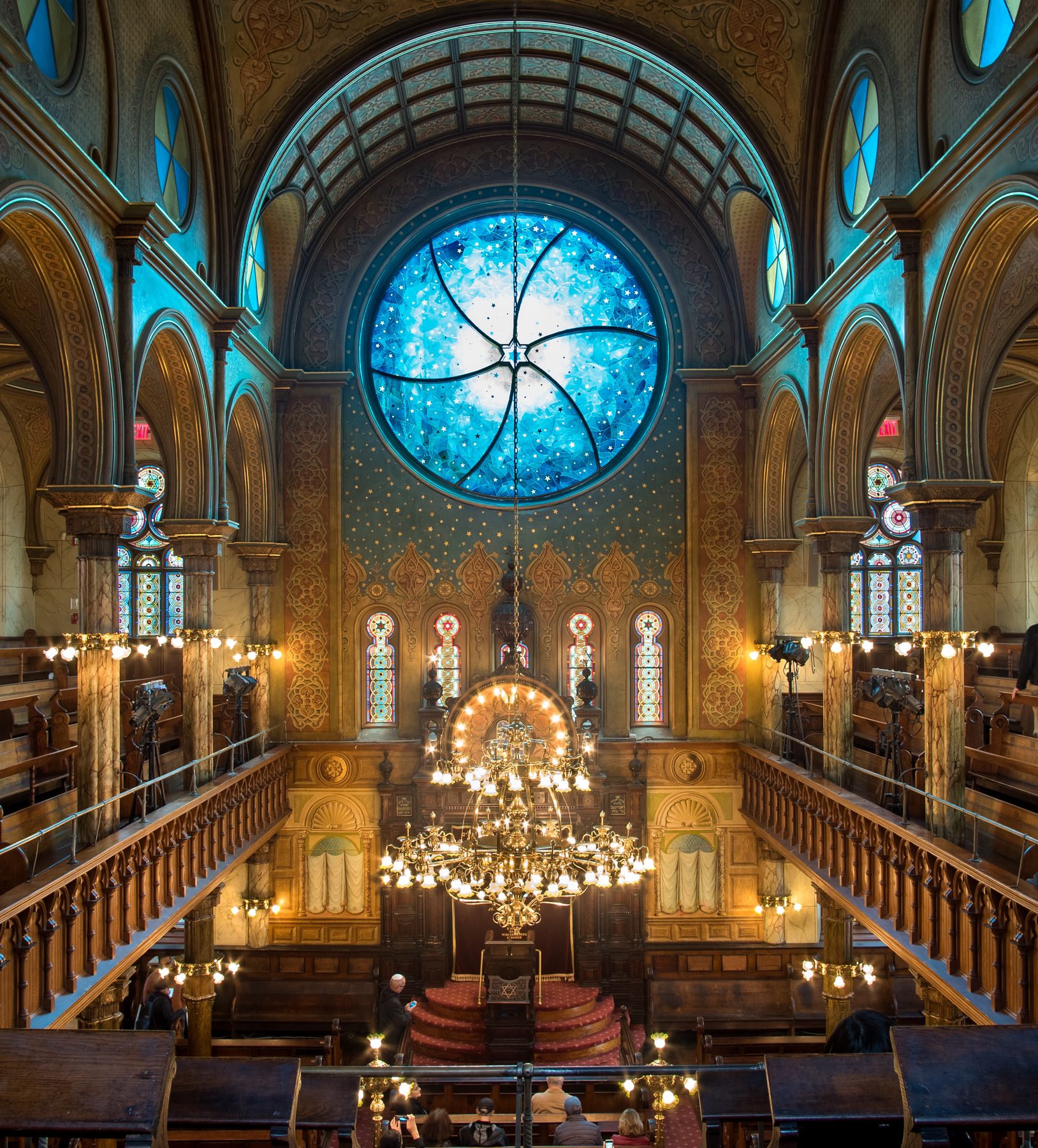
Inside, the sanctuary is a single wide horseshoe-arched hall beneath a star-painted vault, ringed by galleries and lit by stained glass and iron chandeliers converted, over the decades, from gas to electric light. None of this is reconstruction guesswork: the interior survives largely as built, aside from the repairs made after a serious fire, and the congregation's own records, together with the building's landmark documentation, track the physical fabric decade by decade. That kind of paper trail is unusual for a nineteenth-century American religious building still in active use, and it is what allows historians to speak of the synagogue's history with precision rather than legend.
What the building corroborates is not a single sentence of scripture or a single date in a chronicle, but something broader and, in its way, more useful to the historical record: that by the years just before and after the American Civil War, Jewish congregations in New York had the numbers, the capital and the confidence to commission architect-designed, monumental houses of worship in the heart of a growing city, and to build them to last. The structure is the argument. It did not vanish, was not converted to other use, and was not abandoned as its neighbourhood changed around it through more than a century and a half of New York's building booms and busts.
Building and dedication
Central Synagogue, home to the congregation Ahavath Chesed, was built between 1870 and 1872 to a design by Henry Fernbach in the Moorish Revival style, and dedicated on completion. It has served the same congregation on the same site continuously since, making it the oldest synagogue building in New York City in continuous use by its founding congregation.
In situ, Lexington Avenue and 55th Street, New York CityThe fire and what survived it
In August 1998 a fire, caused by construction work on the roof, badly damaged the building, destroying much of the roof structure and threatening the sanctuary below. The congregation undertook a multi-year restoration, working from the surviving fabric and from historical photographs and records, and reopened the sanctuary in 2001. The restoration itself is now part of the object's evidentiary value: it shows, in a documented and dated way, what nineteenth-century decorative painting, ironwork and stained glass in this tradition actually looked like, because conservators had to match it rather than invent it. The building was designated a National Historic Landmark in the 1970s, which means its fabric and history have been formally assessed and are a matter of public record, not congregational memory alone.
None of this needs embellishing. A congregation founded by immigrants built a landmark, kept it, nearly lost it to fire, and rebuilt it faithfully enough that the towers over Lexington Avenue still mean, to anyone who knows the skyline, exactly what they meant in 1872.
Fire and restoration
A fire in August 1998, sparked during roof repairs, severely damaged Central Synagogue's roof and upper sanctuary. The congregation restored the building over the following years, guided by historical documentation of the original decorative scheme, and reopened it for worship in September 2001.
Congregation and landmark restoration records, New York CityFurther reading