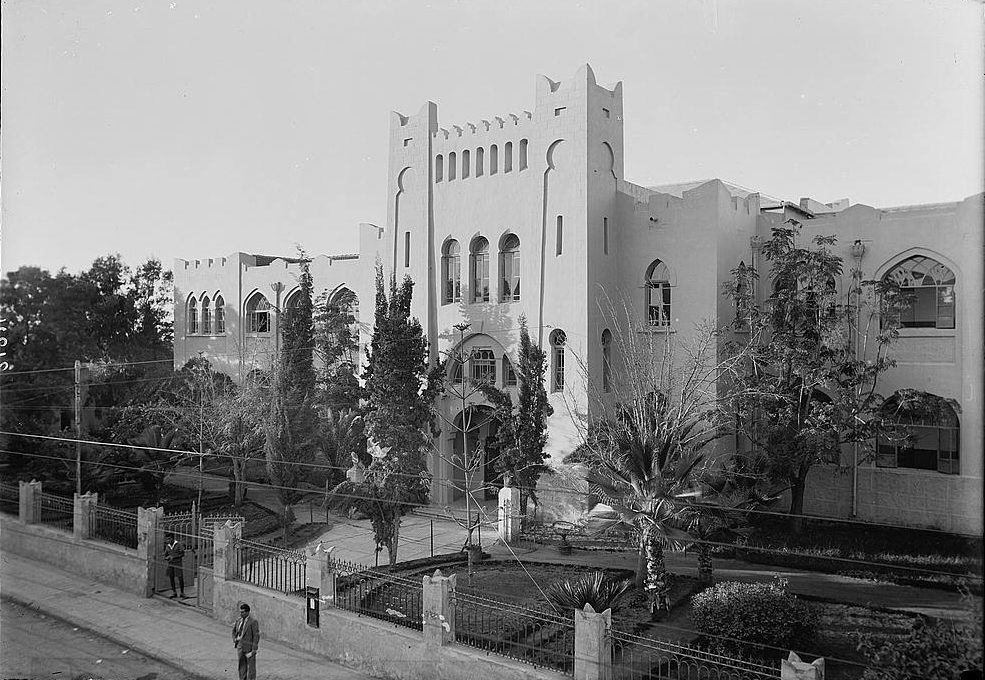
Number 22 Bialik Street, Tel Aviv, is not a grand building. It is a two-storey house with a domed corner turret, decorative brickwork and a small garden, built in the mid-1920s in a city that at the time barely deserved the word city - a handful of streets of sand north of Jaffa, laid out little more than a decade earlier. What makes the house worth a visit is not its scale but its address book: it was built for Chaim Nachman Bialik, the poet whose Hebrew verse is still taught to every Israeli schoolchild, and it survives today essentially unaltered, furnished with his own furniture, his own library and his own papers, on a street that carries his name.
That last detail is worth pausing on before anything else, because it is the kind of fact that sounds like civic flattery and turns out to be checkable. Streets are usually named for the dead. Bialik Street was named for a living resident, and he went on living on it for several more years afterwards - an honour the young Tel Aviv municipality extended to almost no one else in his lifetime. The house, then, is not simply where a famous writer happened to live. It is a building the city itself treated, while he was still inside it, as a monument.

A house built for a language, not just a poet
Bialik settled in Tel Aviv in the mid-1920s, already the most celebrated poet writing in Hebrew and a central figure - as writer, editor and publisher - in the project of turning Hebrew from a language of prayer and scholarship back into a language people used for everything, including poetry about longing and rain and a dead bird found on a windowsill. He had helped found the Dvir publishing house, one of the institutions that gave the revived language a modern literature to read. The house built for him on the street soon named after him was, by any reasonable account, meant to be seen: an eclectic design combining Middle Eastern and European decorative elements, domed and turreted in a way no purely functional house needs to be, in a neighbourhood otherwise filling up with the plainer modernist buildings that would later give the surrounding district its reputation. The house does not blend in. It was not built to.
Bialik lived there until his death in 1934, and the building did the work such houses do: it became, almost immediately, a place where visiting writers, students and admirers of the new Hebrew literature expected to be received. What the house preserves, in other words, is not only a private residence but a kind of unofficial institution of the language-revival movement, furnished and run by one of that movement's own central figures.
The Bialik House
A house built at 22 Bialik Street, Tel Aviv, as the residence of the Hebrew poet Chaim Nachman Bialik, in an eclectic style combining Middle Eastern decorative motifs with contemporary European elements - a domed corner turret and ornamented brick facade set among the city's early residential streets. Bialik lived there from the house's completion until his death in 1934. It stands on its original site, unaltered in footprint, and is now run as a museum by the Tel Aviv-Yafo municipality.
Bialik House Museum, Tel AvivWhat a kept house can prove
A house kept as its owner left it is a different kind of evidence from a manuscript or an inscription. It cannot quote a text, but it can show how a life was actually organised - which room held the books, which held the visitors, what the desk looked like where the poems were written. Bialik House preserves his library and personal effects in place, which means the building functions as a primary source for the material culture of the Hebrew revival: not what its leading figures said about their project in essays and speeches, but what an ordinary working day inside it looked like, in the rooms where it happened.
The revival of Hebrew as a spoken, everyday language is sometimes told as a story led by a handful of committed individuals - lexicographers, poets, teachers - working against the odds to force a liturgical and literary language back into daily use. Historians of the period debate how much weight that account should carry against the broader social forces also in play: waves of immigration bringing speakers of many different languages who needed a shared tongue, and a new school system in Ottoman and then British-ruled Palestine that taught children in Hebrew from an early age, regardless of what any individual writer achieved. The debate is not about whether figures like Bialik mattered - his own literary stature is not in dispute - but about whether a house like this one, preserved as a kind of shrine to one man's role in the revival, risks overstating the part played by a small literary elite against the much larger, more anonymous work of classrooms and immigration.
The preserved interior
The rooms of the Bialik House retain the poet's furniture, personal library and papers, displayed in the spaces they originally occupied rather than removed to a separate exhibition gallery. Interior decoration includes painted ceilings and ornamental detail combining Jewish, Middle Eastern and European motifs, consistent with the eclectic design of the building as a whole. The collection is catalogued and maintained by the Tel Aviv-Yafo municipality as part of its network of house-museums around Bialik Square.
Bialik House Museum, Tel AvivNone of this proves that Hebrew's revival needed exactly this man in exactly this house. What it proves is narrower and no less striking: that a modern Hebrew literary culture had, by the mid-1920s, produced a figure whose own city named a street for him in his lifetime and built him a house worth keeping intact for a century afterwards. A language does not get a shrine like this by accident. It gets one because enough people had already decided, before the house was finished, that the revival had worked.
Further reading