Most ancient synagogues in the Galilee survive as footprints: a rectangle of foundation stones, a scatter of column drums, a floor plan you have to take on trust. Bar'am is the exception. Drive up into the hills near the Lebanese border today and a monumental stone facade still stands close to its original height - three doorways, a run of columns, carved lintels overhead - looking less like a ruin and more like a building that simply stopped being used. It is one of the best-preserved ancient synagogues anywhere in Israel, and it is evidence of something specific: a Jewish village in the Upper Galilee that was not merely present in the Roman period but prosperous enough, and settled enough, to build in stone and build to last.
The site sits within what is now Bar'am National Park, beside the remains of the village of Kfar Bar'am, a short distance from the modern border. Two ancient synagogue buildings have been identified there, referred to by archaeologists as the "great" and the "small" synagogue; it is the great synagogue's facade, with its broad central portal flanked by two smaller doorways, that gives the site its reputation. The masonry is finely dressed local limestone, and the carved decoration above the doors and along the frieze includes rosettes, wreaths and vine scroll - the ordinary decorative vocabulary of the ancient Galilean synagogues, applied here with unusual confidence and scale.

What the stone shows
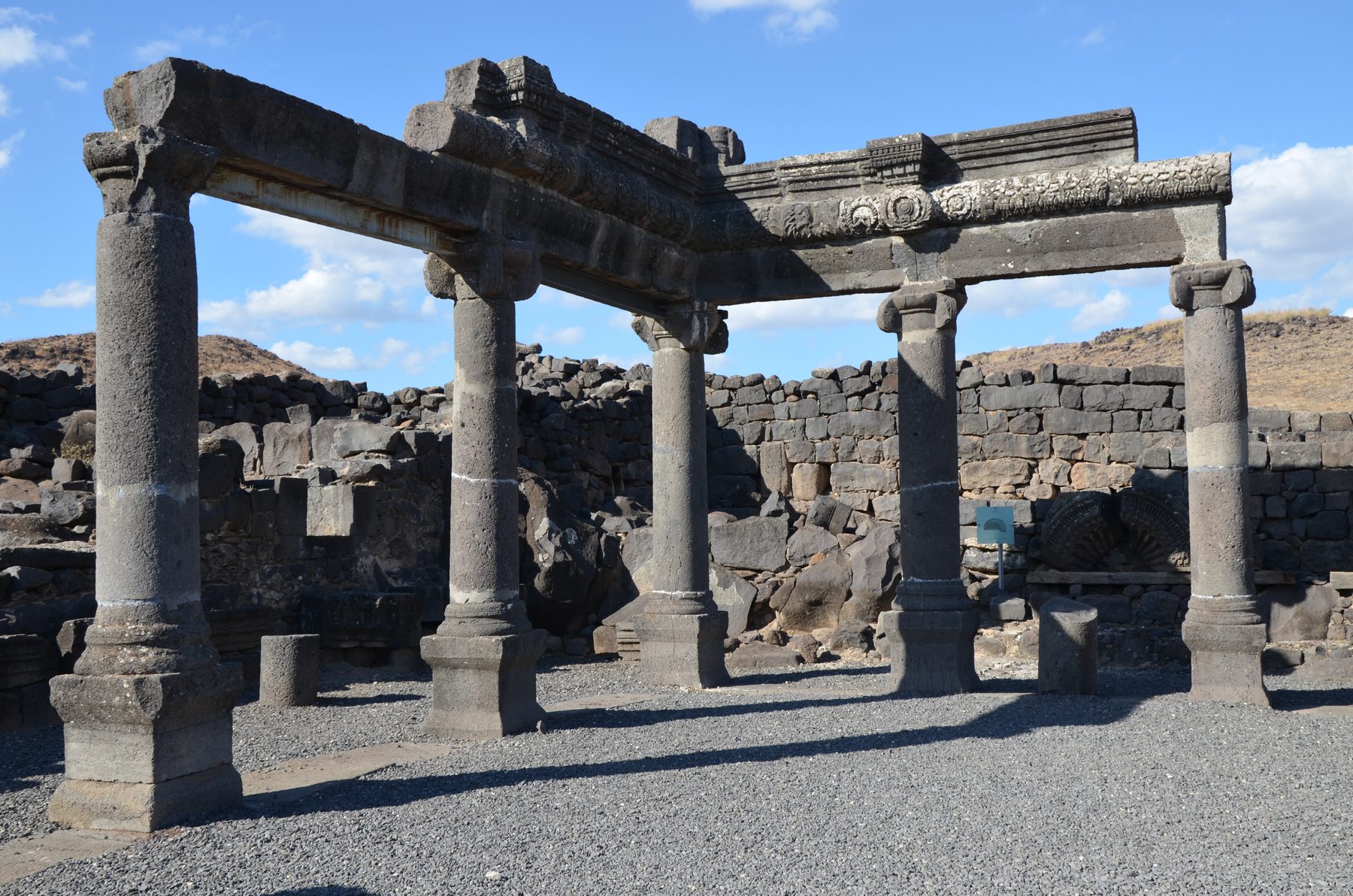
The building belongs to a recognisable family of ancient synagogues built across the Galilee in stone with monumental, richly carved facades facing Jerusalem-ward and a columned interior - a type scholars usually group together as the "Galilean" synagogues, of which Capernaum's white limestone building is the best known. Bar'am's version is unusual chiefly for how much of it still stands unaided: much of the facade wall, several of the columns, and carved architectural elements are still in their original positions rather than reassembled from fallen fragments. That alone makes it valuable evidence, independent of any inscription: a working example of what a Galilean synagogue's public face actually looked like when whole, rather than a plan reconstructed on paper.
The decoration is consistent with what appears at other sites of the type - geometric and floral motifs, wreaths, and architectural mouldings drawn from the wider Roman provincial repertoire, without human figures on the facade itself. That restraint is not unique to Bar'am, but the scale on which it is displayed here, on a facade still standing to something close to its full height, makes the building an unusually direct piece of evidence for the visual world Jewish communities in the Galilee were building for themselves under Roman and, later, early Byzantine rule.
The great synagogue facade
A monumental limestone facade with three doorways, columns and carved decoration, standing close to its original height at the site of ancient Kfar Bar'am in the Upper Galilee. It is grouped by scholars among the "Galilean-type" synagogues alongside sites such as Capernaum and Chorazin, and is exceptional chiefly for its state of preservation: much of the structure stands where it was built rather than having collapsed and been reassembled or reconstructed on the ground.
In situ, Bar'am National Park, Upper GalileeWhen it was built, and the argument about that
Dating the Galilean-type synagogues has been a genuine and long-running argument among archaeologists, and Bar'am sits inside it rather than outside it. One line of reasoning, built mainly from the architectural style itself - the ornament, the mouldings, the way the buildings echo Roman provincial architecture more broadly - has favoured a relatively early date, within the second or third century CE, while Jewish communal life in the Galilee was still recovering and reorganising after the failed revolts against Rome. A second line of reasoning, built from excavated stratigraphy, coins and pottery at sites of the same architectural family, has pushed the main building phase of several of these synagogues later, into the fourth or even fifth century, under Byzantine rule rather than earlier Roman rule. Because Bar'am's facade was never excavated from a sealed stratigraphic sequence in the way some comparable sites have been, its precise date rests more heavily on the architectural comparison than the stratified sites do, and it is generally discussed as belonging to the later end of the Roman period into the early Byzantine period. The disagreement is about a couple of centuries within a well-attested tradition of synagogue-building, not about whether the building is what it plainly is.
What is not in dispute is what the building proves about the village around it. Kfar Bar'am was a Jewish settlement that endured through the Roman period and continued, under changing rule, for centuries afterward - a community that outlasted the revolt against Rome and the harsher restrictions that followed it, and that had the resources and the confidence to raise a public building of this scale and ambition. A facade like this is not built by a community in hiding.
Kfar Bar'am, before and after
The Jewish village of Kfar Bar'am, named in later rabbinic and geographic sources, occupied the site through the Roman and Byzantine periods. In more recent centuries the same site was home to a Christian Maronite village, also called Bar'am or Kafr Bir'im, which was depopulated in the years around Israel's founding; its former residents and their descendants have pursued the question of return through Israeli courts and public life ever since. The ancient synagogue facade and the modern village's story sit on the same hillside, two chapters of continuous settlement in the same place.
Bar'am National Park, Upper GalileeFurther reading