The village of Arbel sits on a shelf of ground below its own cliffs, on the western slope above the Sea of Galilee, close to Migdal and a short walk from Tiberias. Somewhere in the middle centuries of the first millennium CE its Jewish community built a synagogue there, and enough of it survives - foundation courses, column bases, decorated fragments, and above all a grand doorway - to place the building confidently in the family of monumental synagogues that once studded Roman and Byzantine Galilee. It is not the best preserved of that family. It is one of the clearest demonstrations that the family existed at all.
What makes Arbel useful as evidence is not any single spectacular find. It is the combination of an identifiable site, a datable architectural type, and a setting that matches what the texts say about the region: a lakeside district thick with Jewish villages, each apparently able to raise the stone and the skill to build a public house of worship that faced Jerusalem. A synagogue proves a community. A cluster of them, spaced across a few miles of Galilean hillside, proves something closer to a civilisation going about its ordinary religious life.

What is there to see
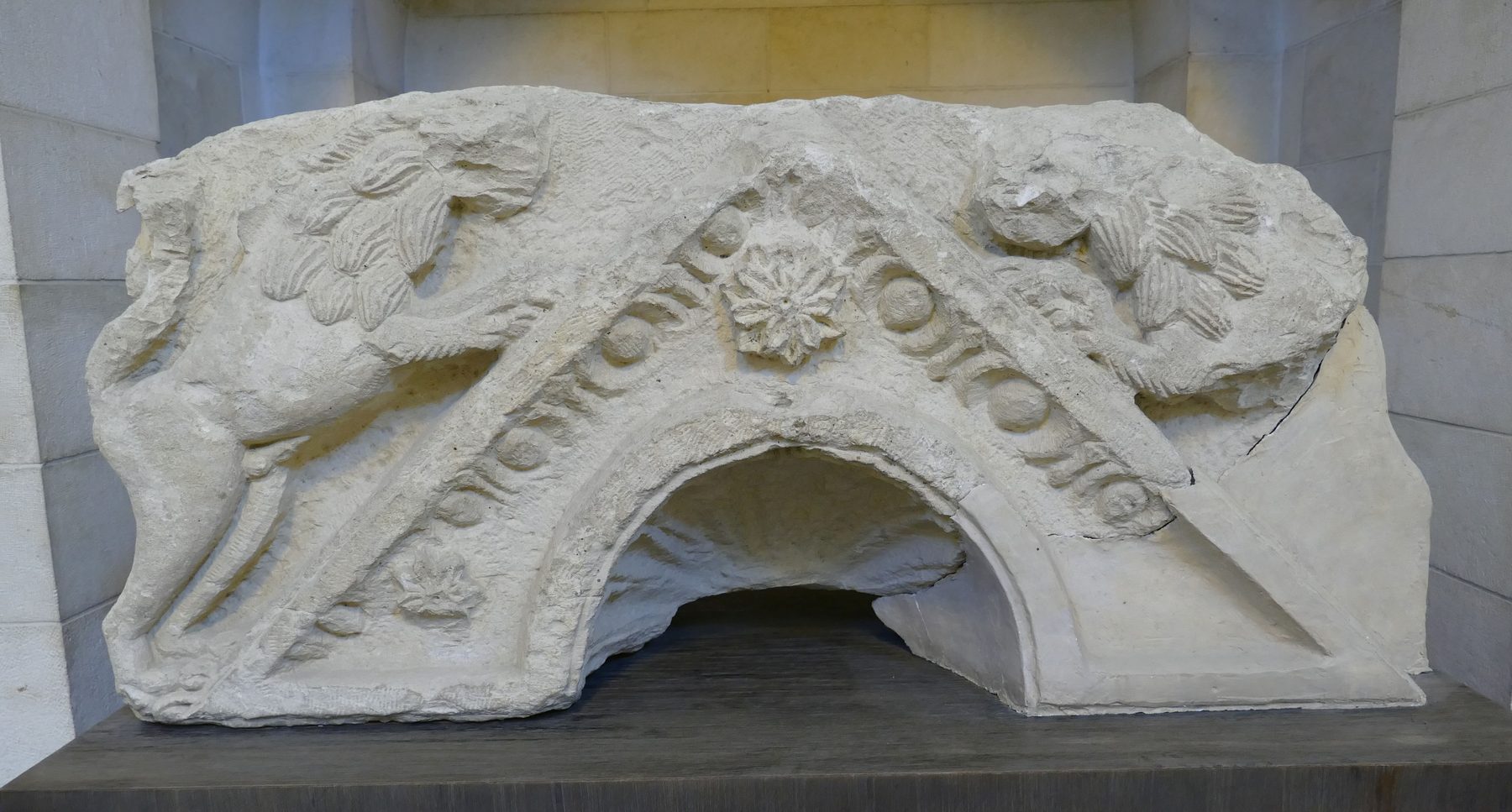
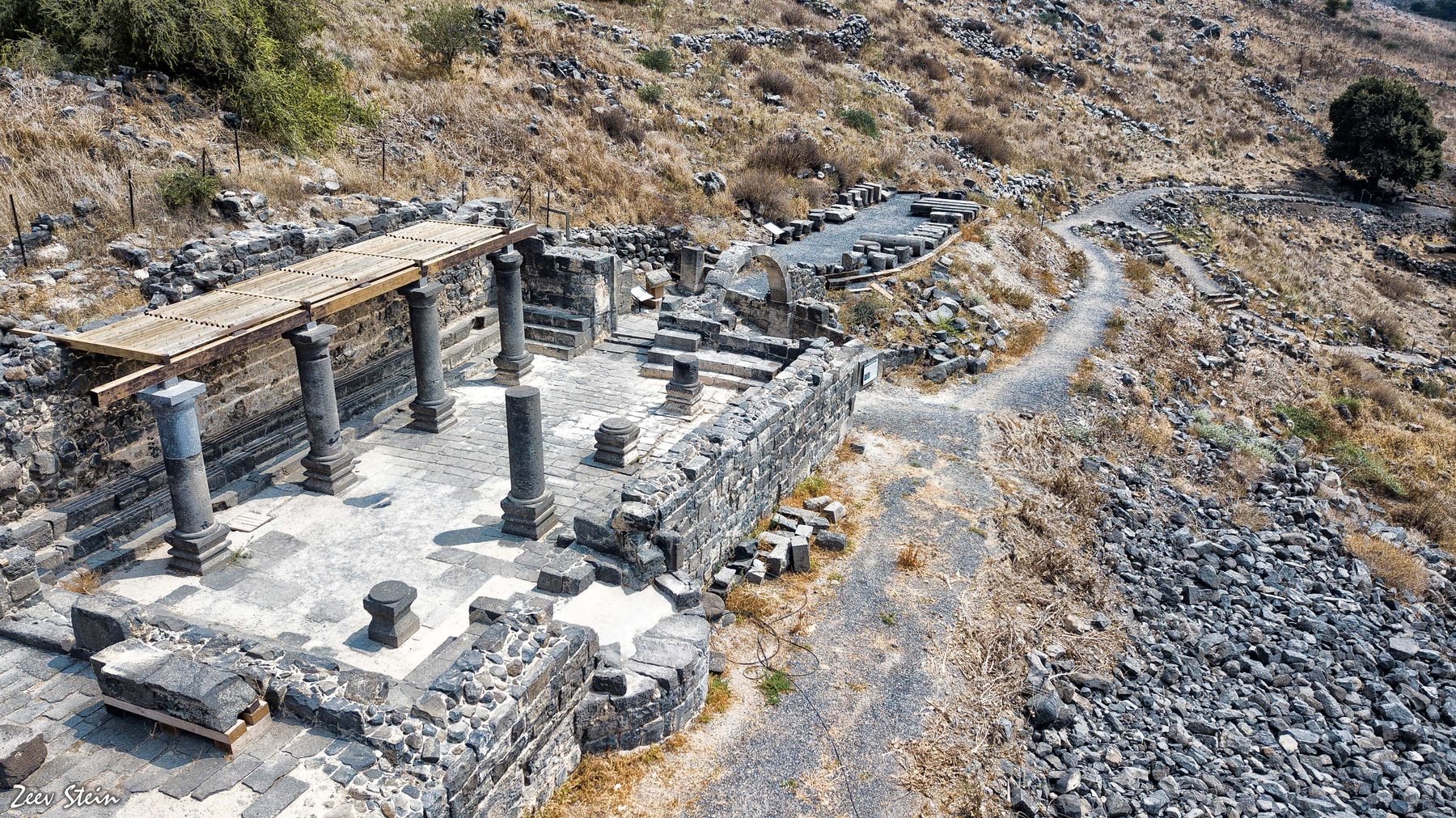
The remains form a rectangular hall built from local basalt, the dark volcanic stone typical of eastern Galilee, dressed with limestone elements for the more visible architectural features. The most striking survival is a large, finely carved doorway on the building's southern side, facing generally toward Jerusalem in the manner expected of a Galilean synagogue's principal entrance - the direction worshippers would face in prayer. Column bases and column fragments mark out where colonnades once divided the hall into a nave and side aisles, a standard arrangement in the larger Galilean synagogue buildings. Carved architectural fragments, including some with decorative motifs, have also been recovered from the site.
None of this is unique to Arbel taken alone. What matters is that it belongs to a recognisable regional type: the so-called Galilean-style synagogue, built in dressed stone with monumental façades and columned halls, examples of which stand at Capernaum, Chorazin, Bar'am, Meiron and elsewhere around the lake and through the upper Galilee. Arbel is one node in that network, and its position - directly below the Arbel cliffs, close to the lakeshore villages the Gospels and rabbinic sources both associate with fishing communities - fixes a Jewish presence to a very specific and evocative piece of ground.
A monumental synagogue on the Arbel slope
The ruin was recorded during the early twentieth-century German survey of ancient Galilean synagogues carried out by Heinrich Kohl and Carl Watzinger, whose published plans and photographs remain a reference point for the whole class of building. Later archaeological work at the site, including excavation and conservation by Israeli archaeologists, has clarified the plan of the hall, its basalt construction and its carved doorway. The building sits within the built-up area of the modern village of Arbel, in situ on the slope below the cliffs, overlooking the Sea of Galilee.
In situ, Arbel, Lower GalileeWhy the date matters
Dating Galilean-style synagogues precisely has long been difficult, because the buildings rarely carry an inscription that names a year, and their stone construction can look similar across a wide span of time. For decades scholars generally placed the type in the second and third centuries CE, reading the architecture as evidence of a flourishing, self-confident Jewish Galilee in the earlier Roman period, not long after the destruction of the Second Temple. Excavations at several sites in this group later produced coins, pottery and other stratified finds pointing to construction or major use in the fourth, fifth and even sixth centuries, well into the Byzantine period - considerably later than the older consensus assumed.
That disagreement is not fully resolved for every site in the group, and Arbel has not been excavated with the intensity of Capernaum or Chorazin, so its own construction date is harder to pin down than the type as a whole. What is not in doubt is the broader implication: whichever end of the range a given building falls on, Jewish communities around the Sea of Galilee kept building, maintaining and using large stone synagogues for centuries after the Temple fell, long past the point at which a purely defeated or dispersed people might have stopped investing in permanent public buildings at home.
The place itself
The cliffs above the synagogue are pierced by caves that served, at various points, as refuges and fortifications, and the valley below opens directly onto the lake at Migdal, a fishing town of some size in the Roman period. A worshipper standing in the synagogue's doorway would have looked out, more or less, over the water the local economy depended on - the same lake worked by the fishermen of the Gospel narratives and named repeatedly in rabbinic discussions of Galilean geography. The building does not need to be read symbolically to make this point; it is simply where it is, and the view from its threshold is part of the evidence, not an embellishment on top of it.
Arbel itself appears by name in rabbinic literature as a place of Torah learning in the Galilee, associated with sages of the Mishnaic period. The later synagogue building is not proof that any particular teacher taught there, but it does confirm that the settlement rabbinic sources name went on, generations afterward, to support a public building of real scale and craftsmanship - the physical footprint matching the literary memory of an inhabited, engaged Jewish village on that stretch of hillside.
One node in a lakeside network
Arbel stands among a cluster of stone-built synagogues excavated around the Sea of Galilee and through the upper Galilee, sharing a common architectural vocabulary of basalt or limestone construction, colonnaded halls and monumental, Jerusalem-facing doorways. Taken together, the group demonstrates a dense, sustained Jewish settlement pattern in the region across the centuries following the destruction of the Second Temple, each village apparently able to fund and build a substantial house of communal worship.
Comparative evidence, Galilee synagogue groupNone of this needs decoration. A doorway aligned toward Jerusalem, a colonnaded hall built from the black stone of its own hillside, a village named centuries earlier in rabbinic sources still standing, still building, still facing the same direction - that is the case Arbel makes, and it is a case made of stone, not argument.
Further reading