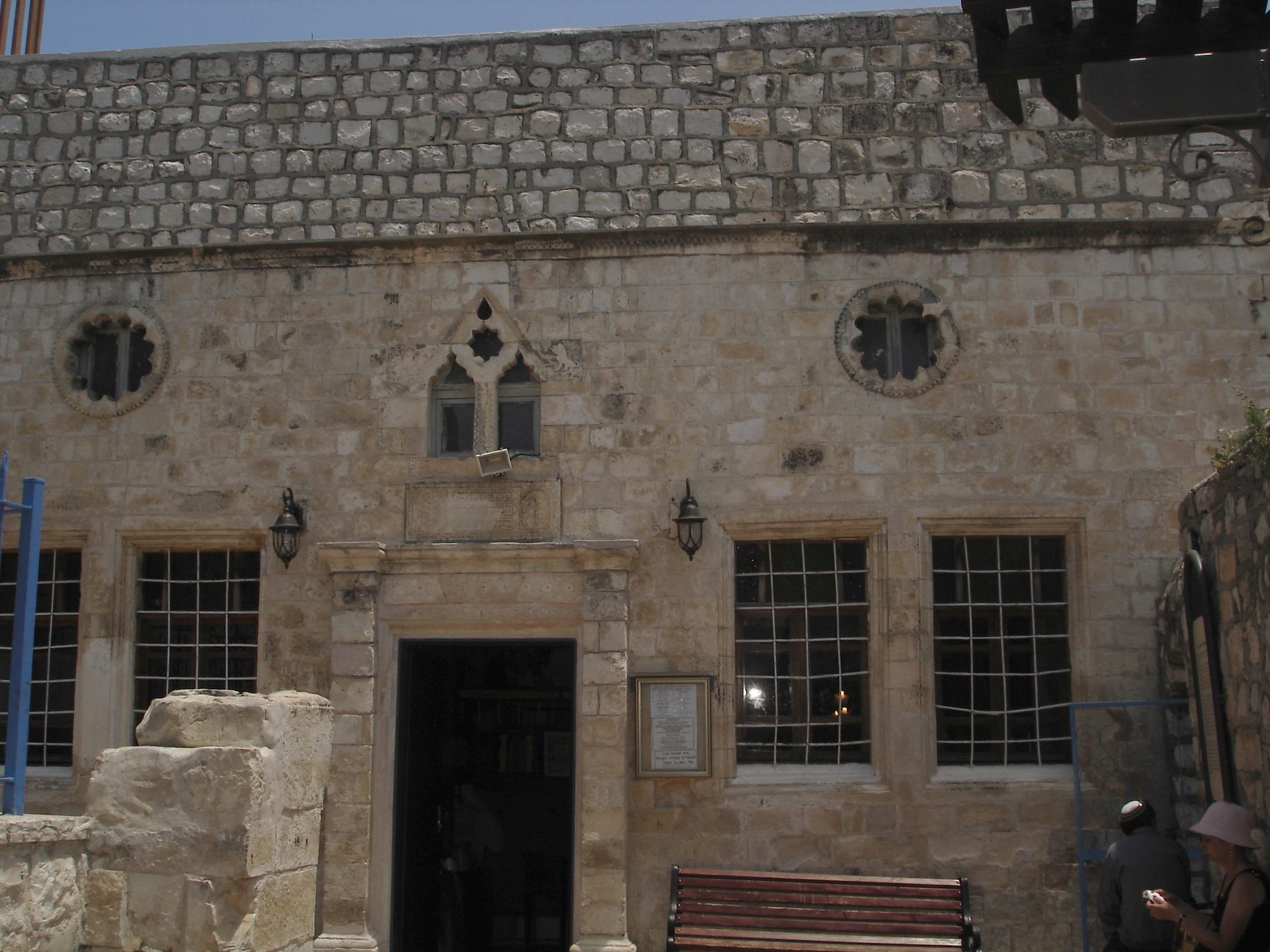
Safed sits high in the hills of the Upper Galilee, cooler and stonier than the coast below, and for a stretch of the sixteenth century it was, improbably, one of the intellectual capitals of the Jewish world. Kabbalists, refugees from Spain and Portugal, legal scholars and printers converged on the town and filled it with study houses. Several of their synagogues still stand and are still in use. The Abuhav Synagogue, in the old town's winding alleys, is named for a Spanish rabbinic authority whose teaching the congregation that built it carried with them - and it is also home to one of Safed's most closely guarded objects: a Torah scroll traditionally attributed to that same authority's own hand.
What makes a building like this useful as evidence, rather than only as atmosphere, is that it has not been reconstructed for visitors. It has simply kept doing what it was built to do. The vaulted ceiling, the raised central reading platform, the deep blue paint on the walls and domes - a colour long associated in local practice with warding off harm and with the blue of the sky as a reminder of the divine presence - are not a stage set assembled for a museum display. They are the accumulated, working fabric of a congregation that has prayed in the same room, more or less continuously, since the town's kabbalistic golden age.

A town built by refugees and mystics
Safed's rise as a centre of Jewish learning followed the expulsion of the Jews from Spain in 1492 and from Portugal a few years later. Among the exiles and their descendants who eventually settled in the Galilee were scholars steeped in Kabbalah, the tradition of Jewish mysticism, and the town became the setting in which some of its most influential later texts were composed and printed. Several synagogues from that period survive in Safed's old quarter, each associated with a particular community of origin or a particular teacher. The Abuhav Synagogue belongs to that cluster of buildings: a working house of prayer whose present form reflects centuries of continuous use, repair and rebuilding on the same site, rather than a single moment of construction frozen in place.
The synagogue takes its name from Rabbi Yitzhak Abuhav, a Spanish rabbinic scholar of the fourteenth to fifteenth centuries. Local tradition holds that congregants who traced their lineage or their teaching back to him founded the synagogue and named it accordingly, and that a Torah scroll believed to have been written by Abuhav himself was carried to Safed and has remained with the congregation since. The scroll is treated with particular reverence: it is customarily kept in its own ark and brought out only on specific occasions in the Jewish calendar, including Yom Kippur and the festival of Shavuot.
A synagogue still in active use
The Abuhav Synagogue stands in the old town of Safed, within the historic Jewish quarter that grew up around the kabbalistic community of the sixteenth century onward. Safed has suffered repeated earthquakes over the centuries, including severe damage in 1759 and again in 1837, and the town's older synagogues, including this one, have been repaired and partially rebuilt more than once as a result. What survives is therefore not a single untouched sixteenth-century structure but a building whose plan, ark and decorative programme have been maintained on the same footprint through successive repairs - itself a kind of evidence, of a community choosing to rebuild rather than relocate.
In situ, Safed old cityThe scroll and the argument around it
The claim that the Torah scroll housed in the synagogue's special ark was written by Rabbi Yitzhak Abuhav himself cannot be independently verified in the way a dated inscription or an excavated find can be. No contemporary fourteenth or fifteenth-century document records its writing, and the chain of custody that would connect a specific scroll across several centuries and a migration from Spain to the Galilee rests on communal tradition rather than on documentary proof. Scholars who study the history of Safed's synagogues generally treat the attribution as a strong and long-held local tradition rather than as an established fact, while noting that the scroll's presence and the community's veneration of it are themselves well attested and of real historical interest, whatever its precise origin. The debate, where it exists, is about the object's authorship and date, not about whether the congregation has genuinely held and used a scroll under this name for a very long time.
None of that uncertainty diminishes what the building demonstrates in plainer terms. It stands as physical confirmation that a Jewish community was established and organised enough in early-modern Safed to build and endow a permanent house of prayer, to maintain it through earthquake damage across centuries, and to keep transmitting a specific set of customs - which festivals bring the special scroll out, which direction the reader faces, which colour covers the walls - unbroken enough that visitors today are told the same practices that congregants would have described a hundred years ago. A synagogue that a community keeps rebuilding on the same spot is a different kind of evidence from a single dated stone, but it is evidence all the same.
Safed's kabbalistic community
Following the expulsions from Spain and Portugal, Safed drew scholars and refugees who built the town into a centre for the study and codification of Jewish law and mysticism. Several synagogues associated with this period, including buildings linked to communities of Spanish, Sephardi and Ashkenazi origin, survive in the old city and remain active places of worship. Their continued use, alongside the wider historical record of Safed's growth as a centre of Jewish scholarship in this period, corroborates the town's role as one of the major hubs of post-expulsion Jewish life in the Land of Israel.
Safed old city, historic Jewish quarterFurther reading