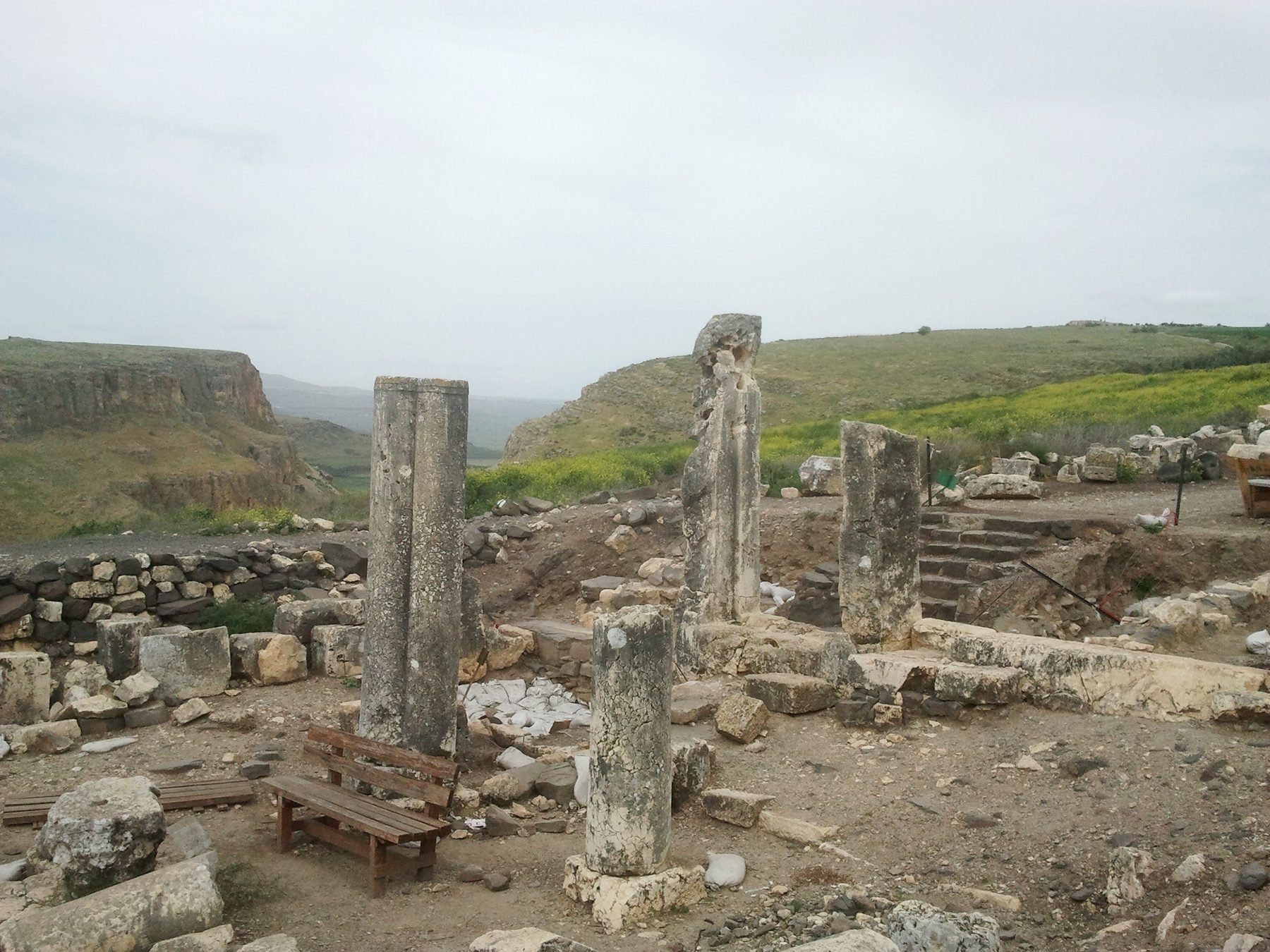
Tel Hai is a small courtyard settlement in the far north of the Galilee, close enough to the modern Lebanese border that on a clear day you can see the hills the fighting once came over. What happened there on a single day in 1920 was not large by the standards of the century that followed it - a handful of settlers, an attack, a defence that failed to hold the position but did not fail to matter. What survives is the courtyard itself, largely as it stood, and, on a hill a short walk away at Kfar Giladi, a carved basalt lion set over the graves of the dead. Between them they are as plain a piece of evidence as this site offers: a place, a stone, and a story that can be checked against both.
The context is worth stating without embellishment. In late 1919 and early 1920, the handful of Jewish settlements in the Upper Galilee panhandle sat in a genuine no-man's-land - beyond the effective control of the British administration to the south, inside a zone the French Mandate authorities claimed but did not garrison, and exposed to raiding from armed bands moving through the area amid the wider unrest following the Ottoman collapse. Tel Hai and its sister settlement Kfar Giladi were isolated, thinly defended farming outposts, not fortresses. Joseph Trumpeldor, a veteran of the Russian army who had lost an arm at Port Arthur and gone on to help raise the Zion Mule Corps in the First World War, had come north to help organise the settlements' defence.

What happened at the courtyard
On the first of March 1920, an armed group entered the Tel Hai courtyard, ostensibly to search it, in an atmosphere already thick with suspicion on both sides. A fight broke out inside the yard. Trumpeldor and several other defenders were killed, along with Arab attackers, in the close, confused violence of a small courtyard rather than a set battlefield. Tel Hai itself was abandoned within days - the settlers withdrew southward for a period along with those from Kfar Giladi and Metula, judging the position indefensible without external support. In the narrowest military sense, the defence did not hold the ground.
What it held was something else. The line attributed to Trumpeldor as he lay dying - that it is good to die for one's country - became one of the most repeated sentences in early Zionist culture. The familiar English wording is disputed; the heritage source records a variant, and the line is used here as the widely known form, not a secure transcription. It mattered whatever its exact wording and however it was first recorded. Tel Hai and Kfar Giladi were resettled soon afterwards, and the wider Galilee panhandle, including the area around Tel Hai, was fixed within the boundary of the future Mandate for Palestine rather than left to the French zone to the north. The defenders did not keep the courtyard. Their deaths are one of the reasons the ground it stood on stayed part of the map that followed.
The Tel Hai incident
An armed clash inside the courtyard of the Tel Hai settlement in the Upper Galilee left Joseph Trumpeldor and several other Jewish defenders dead, along with Arab attackers, amid the unsettled conditions of the immediate post-Ottoman period. The settlement was briefly evacuated and resettled within the year. The courtyard survives largely as it stood and is open to the public as a heritage site.
Tel Hai courtyard, Upper Galilee - in situThe lion above the graves
The monument that answers the courtyard sits a short distance away, on a hillside above the cemetery at Kfar Giladi where the eight defenders who died at Tel Hai are buried. It is a large recumbent lion, carved from local basalt - the dark volcanic stone of the Galilee itself, rather than an imported marble - set on a plinth above the graves, head raised, mouth open. It was made by the sculptor Avraham Melnikov and unveiled in the early 1930s, becoming one of the first purpose-built national memorials of the pre-state Jewish community in the land. Beneath it, cut into the stone, runs the line associated with Trumpeldor: that it is good to die for one's country.
As a piece of evidence the lion proves something narrower than the battle itself, and no less real for that. It shows how quickly, and in what material, an event of 1920 was judged worth permanent commemoration by the community that experienced it - not in wood or plaster but in basalt quarried from the same landscape the defenders had died defending, built to outlast the people who remembered the day first-hand. The monument and the eleventh of Adar, the Hebrew date of the incident, are still marked together each year, at the site itself and in schools and youth movements across the country.
The Roaring Lion, Kfar Giladi
A recumbent basalt lion, carved by the sculptor Avraham Melnikov and set above the cemetery at Kfar Giladi where the eight Tel Hai defenders are buried. The inscription carries the line associated with Trumpeldor's last words. It stands today as one of the earliest national memorials built by the pre-state Jewish community, still in its original setting and still the focus of the annual Tel Hai commemoration on the eleventh of Adar.
Kfar Giladi cemetery, Upper Galilee - in situThe defenders did not keep the courtyard. Their deaths are one reason the ground it stood on stayed on the map that followed.
What Tel Hai offers, in the end, is unusually direct as evidence goes. There is no inscription to translate, no fragment to date by chemical analysis, no attribution to argue over across centuries. There is a courtyard you can stand in, a cemetery you can walk to from it, and a lion carved from the stone of the hill itself, put there within a decade of the event by people who had known the dead. The debate that remains is a narrow and honest one - about the exact wording of a dying man's last sentence - not about whether the defence happened, who died in it, or where they are buried. That is about as checkable as a piece of twentieth-century history gets.