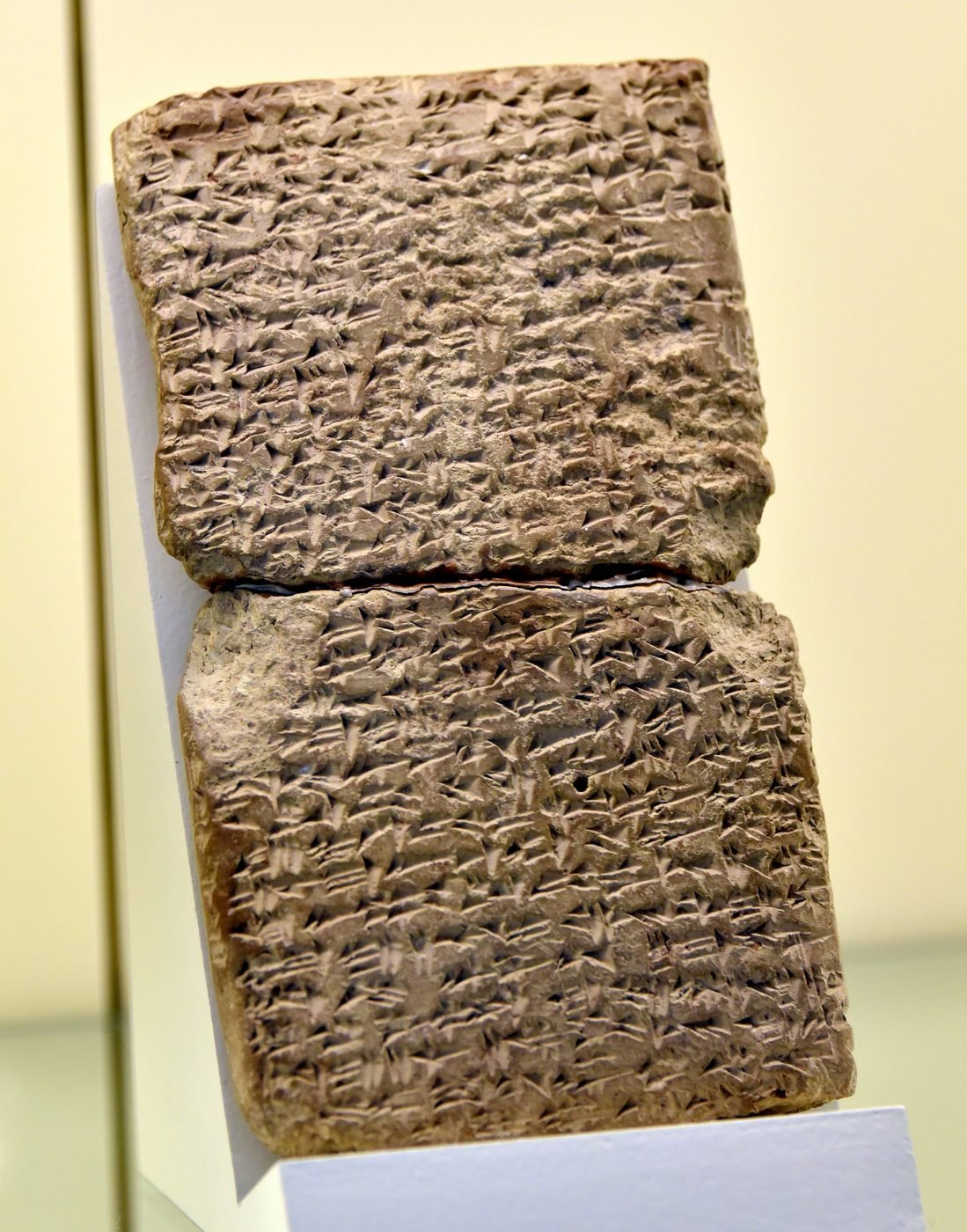
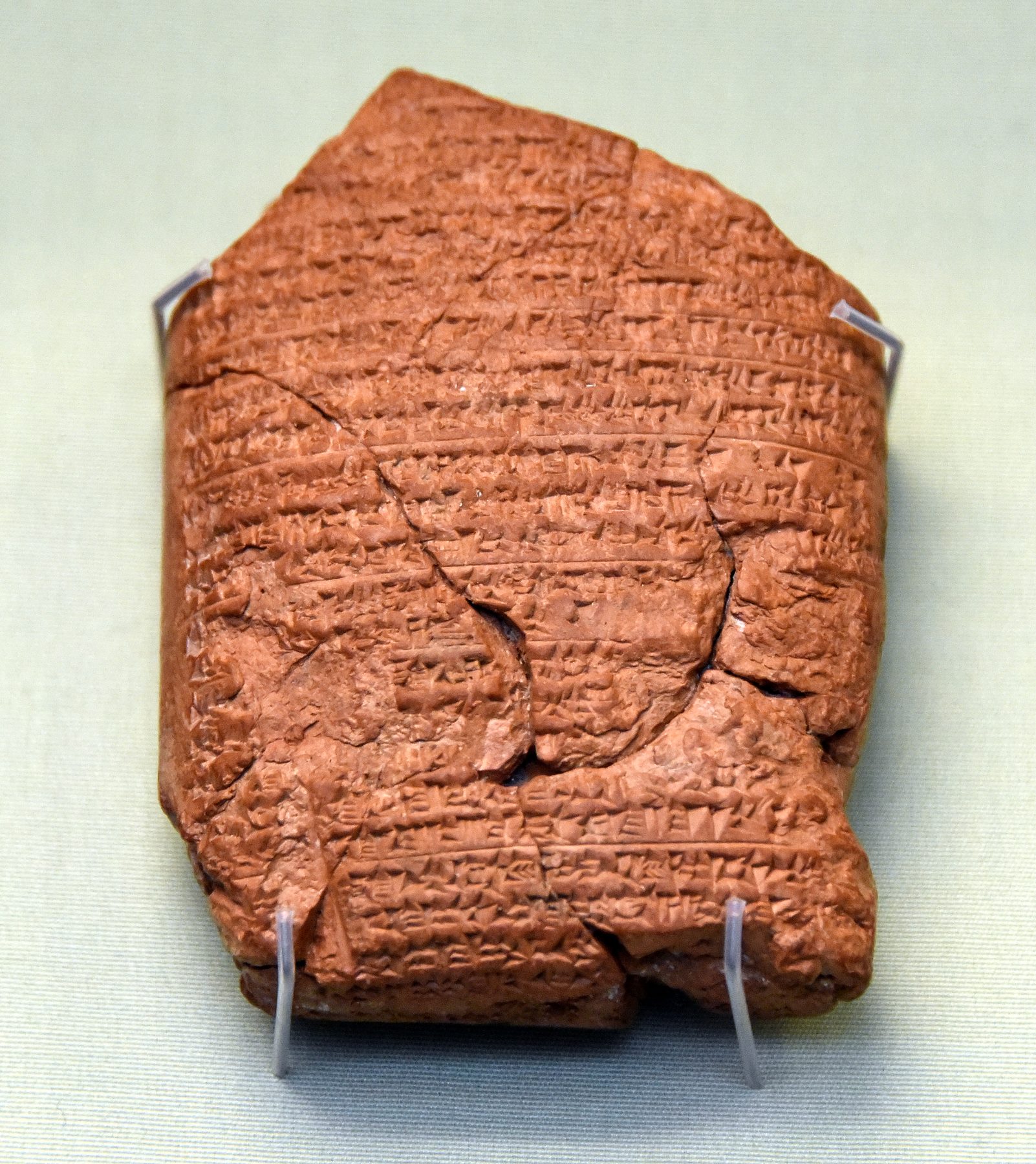
A clay prism, six-sided and covered in cuneiform, was made in Nineveh to record the military achievements of the Assyrian king Sennacherib. Among the campaigns it lists is one against the kingdom of Judah, and it names the king it found on the throne there: Hezekiah. This is not a Jewish document. It is an Assyrian royal inscription, written by the winning side for its own archives, and that is exactly what makes it worth reading carefully. When your enemy's own boast lines up with your own record, the boast is doing work your record cannot do alone.
The find belongs to a class of object called an Assyrian royal inscription, or more specifically a foundation or building prism - clay cylinders and prisms molded and inscribed to commemorate a king's building works and military campaigns, then deposited in the fabric of a building or kept in a palace archive. Several inscribed prisms and cylinders recording this same Judah campaign survive in different collections; the example generally best known to the public is held at the British Museum in London, and related exemplars and fragments are held by other institutions, including the Oriental Institute of the University of Chicago. They were made from the same royal composition, copied out by scribes for different purposes, which is itself part of why historians trust the text: it was not a one-off claim but a formula repeated across multiple physical copies.
What it says
The inscription describes Sennacherib's campaign of 701 BCE, in which the Assyrian army swept through the towns of Judah, captured a great number of them, and took an enormous quantity of plunder and captives. It then turns to Hezekiah himself, and the line most quoted in every discussion of this object states that the Assyrian king shut Hezekiah up in his royal city, Jerusalem, like a caged bird. It goes on to describe siege works thrown up around the city, and it records that Hezekiah eventually sent tribute to Nineveh - a substantial payment in gold, silver and other goods, delivered after Sennacherib's return home.
What the text does not say is the detail that leaps out to anyone who reads it against the biblical account. Sennacherib boasts of shutting Jerusalem in, of penning its king inside like a bird in a cage. He does not boast of taking the city. For a king whose inscriptions elsewhere are frank and detailed about captured cities, sacked temples and deported populations, the silence at exactly this point is conspicuous. He describes the cage. He never claims to have opened it.
A royal boast, not a battle report
The prism is a piece of Assyrian court propaganda, composed for Sennacherib's own audience, not a neutral chronicle. It lists Judahite towns taken, tribute received and Hezekiah confined in Jerusalem - and stops there. No fall of the city, no deposed king, no annexation of Judah into an Assyrian province, all of which the same royal scribes recorded plainly elsewhere when they happened. The claim of tribute is corroborated independently by the biblical account in the Book of Kings, which also describes Hezekiah paying Sennacherib after the invasion, though the two accounts differ on the order and detail of events.
British Museum; related exemplars, Oriental Institute, University of ChicagoWhy it matters as evidence
The value of the prism is not that it proves a miracle or settles a theological argument. It is that it establishes, from a source with every incentive to inflate its own success, a set of facts external to Jewish memory: that a kingdom of Judah existed in the late eighth century BCE, that it had a king named Hezekiah, that Jerusalem was that kingdom's capital, that Assyria besieged it, and that the siege did not end in the city's capture. Each of those points could, in principle, have been invented later inside a purely internal Jewish tradition. Found instead on a clay prism made for an Assyrian king's own use, with no reason to flatter Judah, they become independent corroboration rather than self-report.
Where the record shows a live argument, it is over cause rather than fact. Historians agree the siege happened and that Jerusalem was not taken. What is debated, and reasonably so, is why: whether disease in the Assyrian camp, a threat elsewhere in Sennacherib's empire, the payment of tribute, the strength of Jerusalem's defences and its water supply, or some combination of these, brought the campaign to a stop short of conquest. The prism itself offers no explanation beyond the tribute payment; the rest of the debate depends on how much weight to give the Assyrian silence, the biblical narrative, and the practical realities of an eighth-century siege.
From Nineveh to the glass case
The prism belongs to a corpus of Sennacherib inscriptions recovered from the site of ancient Nineveh, near modern Mosul in Iraq, during nineteenth and twentieth-century excavation of the Assyrian royal capital. Multiple copies of this campaign record are known, differing slightly in wording and condition, which is normal for texts a scribal workshop produced more than once. The best-known complete example is on public display at the British Museum; other fragments and related prisms are held in academic and museum collections including the Oriental Institute.
Nineveh, ancient Assyria - excavated siteSet beside the biblical account in Kings, Chronicles and Isaiah, which also has Sennacherib's army withdraw from Jerusalem without taking it, the prism is not offered here as proof of any supernatural cause those texts describe. It is offered as what it plainly is: an Assyrian king's own words, carved in his own script for his own purposes, agreeing with the Jewish record on the shape of the event while staying conspicuously quiet at the one point where a real Assyrian defeat would have been true news. That kind of agreement, arrived at from opposite directions and for opposite reasons, is the most useful kind evidence gets.
Further reading