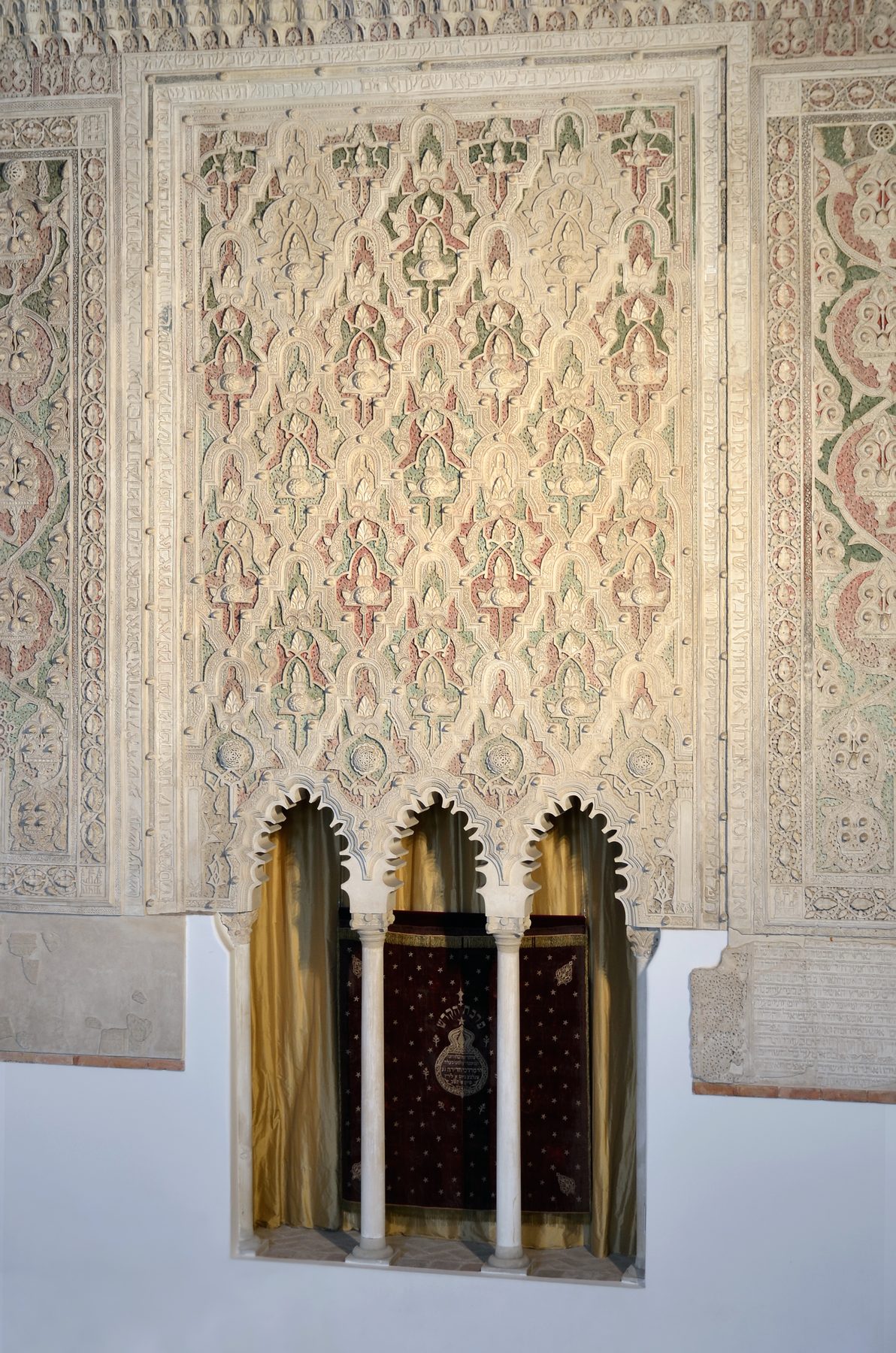
Walk into Santa Maria la Blanca in Toledo today and the first thing the building tells you has nothing to do with its current name. Five aisles run the length of the hall, divided by horseshoe arches carried on octagonal brick pillars, the capitals cut with pine cone and vegetal ornament in the Mudejar manner. It is a plan and a decorative language borrowed wholesale from the mosque architecture of al-Andalus, executed for a congregation that was neither Muslim nor building a mosque. The people who commissioned this room were Jews, worshipping under Castilian Christian rule, in a city where three faiths had spent centuries learning each other's craftsmen. The cross that now sits above the later high altar was added afterwards, by different hands, for a different purpose. The horseshoe arches were there first.
That sequence, arches before cross, is the whole argument of the building. Santa Maria la Blanca is not a story told about Jewish Toledo. It is a room Jewish Toledo actually stood in, still roofed, still standing on its original site in what was the city's Jewish quarter, and still legible enough that a visitor can trace the outline of a synagogue underneath everything that was added on top of it later.

What the building shows
The hall was raised in the twelfth century, in the decades after Toledo passed from Muslim to Christian rule, at a time when the city's Jewish community was large, established and prosperous enough to commission a substantial building. Nothing about the architecture argues for a Jewish patron in isolation: the horseshoe arch, the octagonal pier, the carved capitals and the whitewashed plaster are the standard vocabulary of Mudejar building across Castile in this period, used indifferently for mosques, synagogues and later churches by the same pool of craftsmen. What marks this room as a synagogue is its plan, oriented and organised for congregational Jewish worship, and the documentary and traditional record that names it as one from its earliest years. Some later tradition attaches its foundation to a named Jewish courtier of Toledo, though the building's own fabric does not record a founder's name, and that attribution should be read as tradition rather than settled fact.
The synagogue functioned as such for roughly two and a half centuries. Its history changed abruptly in the aftermath of the anti-Jewish violence that swept Castile and Aragon in 1391, and again in the wave of forced preaching and conversion campaigns that followed in the early fifteenth century. In the early 1400s the building was seized and consecrated as a church, taking the name it still carries. A large altarpiece and choir screen were installed inside the nave, and a cross was raised over what had been the synagogue's sanctuary end. The horseshoe arcades were not torn out. They were built around and left standing, and it is that incomplete overwriting - church furniture inserted into an unaltered synagogue skeleton - that makes the site legible today as both things at once.
From synagogue to church, arcade unchanged
Raised in the twelfth century as a synagogue in the Mudejar idiom of Christian Toledo, the building served the city's Jewish community for around two hundred and fifty years before being seized and reconsecrated as a church in the early fifteenth century, in the period of anti-Jewish preaching campaigns that followed the 1391 violence. The horseshoe arcade, octagonal piers and carved capitals of the synagogue interior were retained rather than demolished, and remain visible beneath the later Christian fittings.
Held in situ, Toledo, SpainWhy it matters as evidence
Santa Maria la Blanca is often introduced as a curiosity, a synagogue that looks like a mosque, and that description is accurate as far as it goes. Its real evidential weight lies elsewhere. It demonstrates, in stone rather than in text, that medieval Iberian Jews were not a walled-off minority using a separate architectural language of their own invention. They were patrons within the shared building culture of their city, commissioning craftsmen who also worked for Muslim and Christian clients, and producing a building indistinguishable in style from the mosques of al-Andalus and from Mudejar churches raised only a little later. The Jewishness of the space was a matter of function and community, not of a distinct visual vocabulary - a fact easy to state and much harder to see, until you are standing under the arcade.
The building is equally blunt evidence for what followed. The seizure and conversion of a functioning synagogue into a church, in a period of coerced preaching and mounting pressure that would end in the 1492 expulsion of Spain's Jews, is not a claim resting on a single chronicler's account. It is legible in the fabric itself: a Jewish sanctuary with a cross installed at its head. Toledo's Jewish community did not vanish quietly from the historical record. One of the rooms it built is still standing to show exactly how its presence there ended.
The arches were not built to argue anything. They simply outlasted the argument that was made over them.