In a quiet valley west of Amman stand the ruins of a building too grand for its setting: monumental ashlar walls, some blocks cut on a scale rarely attempted anywhere in the Hellenistic Levant, with carved lions and an eagle worked into the stone. Above the valley, cut into the rock face beside a row of chambers, a name is carved in Aramaic letters: Tobiah. Nothing else at the site announces its owner. The name does the work. This is Araq el-Emir - Iraq al-Amir in modern Jordanian usage - and it is one of the few places where the biblical and Josephan record of a real Jewish family, wealthy, controversial and thoroughly entangled in the politics of the Persian and Hellenistic Near East, can be checked against stone still standing where it was built.
The building the local Arabic name calls Qasr al-Abd, "the Castle of the Servant," is not a fortress in the practical sense and was probably never finished. It reads as a display piece: a two-storey hall raised on a podium, faced with some of the largest dressed stones known from the Hellenistic world, decorated with relief carvings of big cats and at least one eagle. It sits in open country, away from any city, the kind of building a very rich family puts up to be looked at rather than to be defended. That combination of scale, isolation and ostentation is itself a piece of evidence: someone here had resources and confidence enough to build like a king, in a province that had no king.

A name older than the family that built the palace
The Tobiah carved above the caves is not a new name in the story. A Tobiah appears in the Book of Nehemiah as "the Ammonite servant," a Transjordanian official who opposed the rebuilding of Jerusalem's walls in the fifth century BCE and who is described, awkwardly for his opponents, as connected by marriage to prominent Jerusalem families. Whether that fifth-century Tobiah is the same man commemorated at Araq el-Emir, an ancestor of the family that built the palace, or simply a namesake, is exactly the kind of question the inscription itself cannot settle on its own. What the site does show is that a family bearing this name held land and influence in this part of Transjordan across a very long span, and that by the Hellenistic period their standing had grown enormous.
The later chapter of that family's story is told, at length and with evident relish, by the first-century CE historian Josephus, in his account of the Tobiads in the Antiquities of the Jews. Josephus describes a Tobiad named Hyrcanus, younger son of the tax-farmer Joseph, who fell out with his brothers, withdrew across the Jordan, and built himself a fortified residence in the territory his family already held - a building Josephus describes in terms that match the site's scale and its animal reliefs strikingly well. Josephus places Hyrcanus's end around the accession of Antiochus IV Epiphanes in the 170s BCE, which is the anchor most discussions of the palace's date work from.
The Tobiah inscriptions
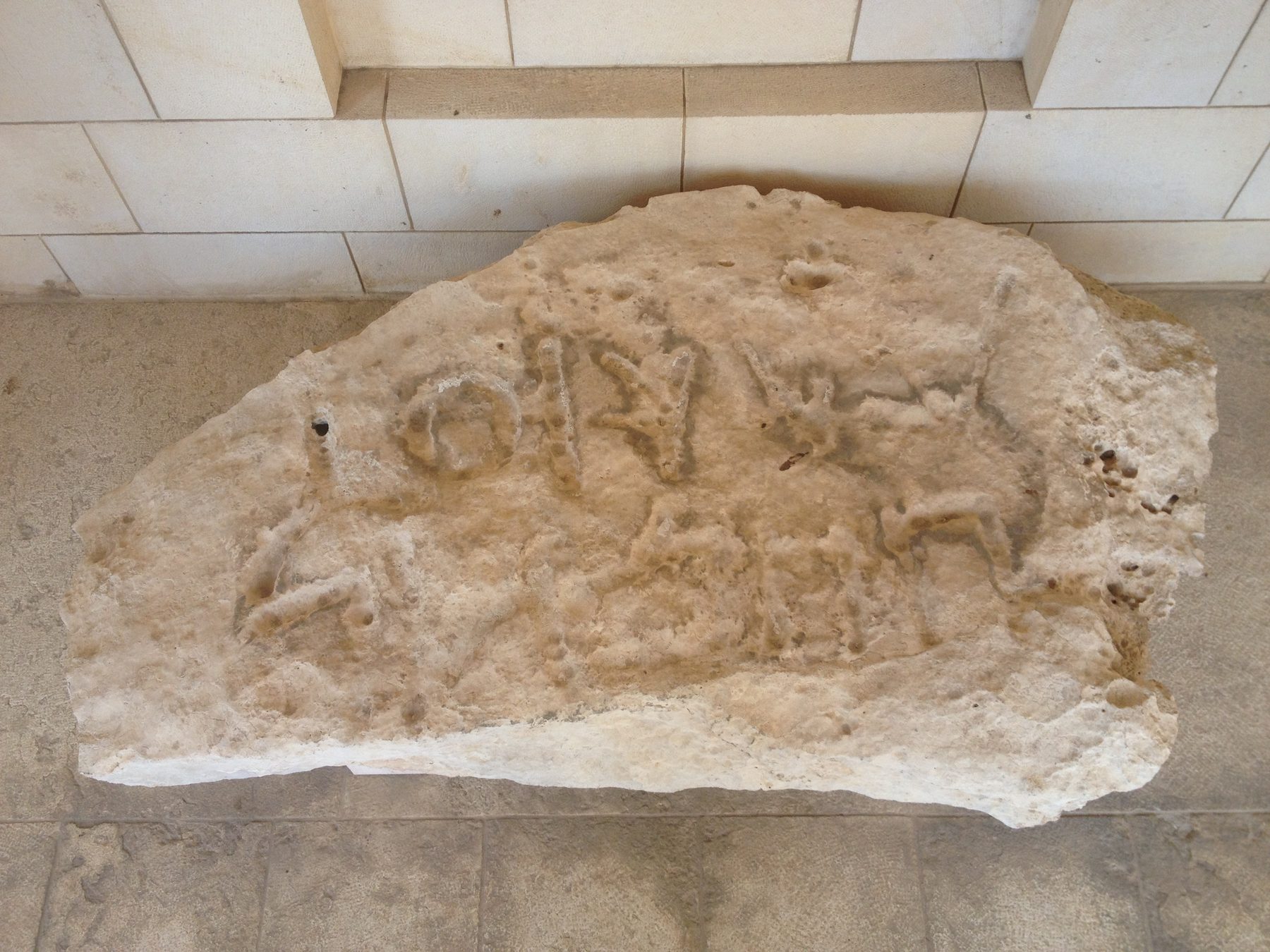
Cut into the rock face beside two artificial caves above the valley floor, in large monumental Aramaic letters, is the name Tobiah - written twice, at the entrances on either side. The script has been studied closely by epigraphers because letter forms can be dated on their own terms, independently of any historical argument about who the builder was. Most palaeographic assessments place the carving in the Hellenistic period, broadly consistent with a Tobiad grandee of the third to second centuries BCE rather than with the Tobiah of Nehemiah's own time some centuries earlier. The caves themselves, cut deep into the cliff, are usually read as stables or storage rather than tombs, though their exact original use is still debated.
In situ, Araq el-Emir, JordanFurther reading
What the stone actually proves
Set the polemic to one side and the evidence is precise about a narrower claim, and that narrower claim is the valuable one. A family calling itself Tobiah, embedded by marriage and office in Jerusalem's governing class, held real territory and real wealth in Transjordan across the Persian and Hellenistic periods, and left a building there large enough, and inscribed clearly enough, to still be standing and legible more than two thousand years later. That is not a small thing to be able to check. Ancient historians write about grandees and tax-farmers constantly; it is unusual to be able to walk up to the actual gatepost one of them carved his family's name into.
It also fixes something the biblical text leaves loose. Nehemiah's Tobiah reads, on the page, like a local troublemaker - "the Ammonite servant," a stock adversary. The palace insists otherwise. Whoever built it commanded the kind of surplus labour and imported skill that produces monumental ashlar masonry and figural relief carving in a rural valley with no city to justify it. The family the biblical narrator wanted to diminish was, on the ground in Transjordan, building like it answered to nobody. Stone and text correct each other here, and the correction runs toward the family, not against it.
Qasr al-Abd, the palace itself
The standing ruin is built of exceptionally large dressed limestone blocks, arranged as a two-storey structure on a raised platform, originally set within a moat or pool. Surviving relief carving includes large feline figures and an eagle worked directly into the masonry - Hellenistic in style, and unusual for their scale in any building of this period in the southern Levant. The structure appears to have been left unfinished, and much of it has since collapsed and been partially re-erected during modern conservation work.
In situ, Araq el-Emir, JordanFurther reading
None of this needs defending. A Transjordanian Jewish family, wealthy enough to be resented in Jerusalem and confident enough to build a palace with its own name cut into the rock, is exactly the sort of textured, unflattering, entirely believable detail that a story confident in itself can afford to keep. The sources are not kind to the Tobiads. The stone does not care. It simply confirms that they were exactly as real, and exactly as grand, as their enemies complained.